You send the same container details to two drayage companies and get back two quotes that look nothing alike. One is noticeably cheaper, the other spells out four line items you’ve never heard of. It’s confusing, and it’s the single most common frustration shippers have when pricing container moves.
The gap usually isn’t because one carrier is cheating you. It’s because drayage quotes are built differently, and the “cheap” one often leaves out costs that show up later. Here’s why the quotes diverge, what’s really inside them, and how to compare drayage companies fairly.
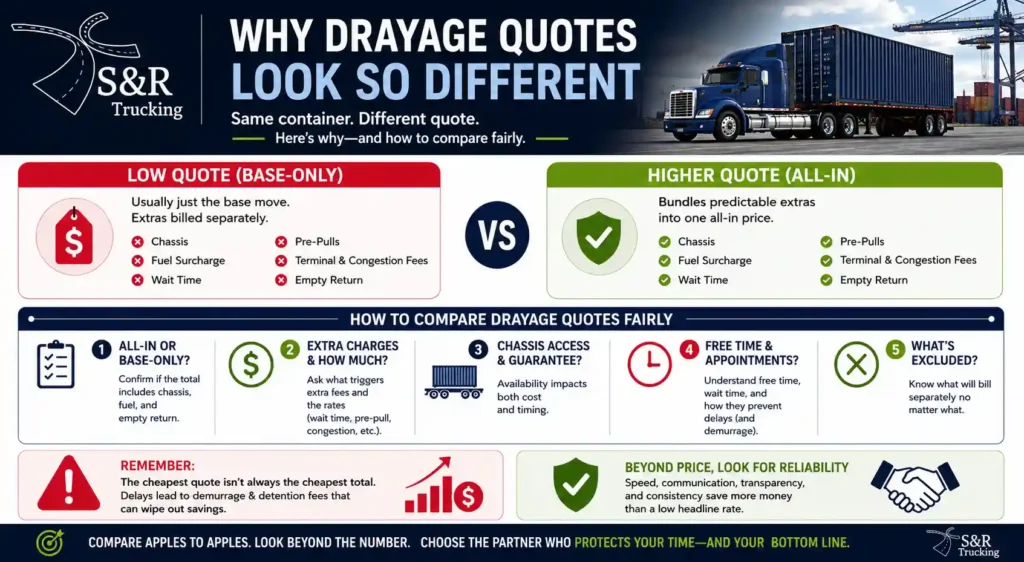
Two drayage companies quote the same container differently mainly because of what each one includes. A low quote is often just the base move, with chassis, fuel, wait time, pre-pulls, and accessorials billed separately, while a higher all-in quote bundles them upfront. The cheapest number isn’t always the cheapest total, because a carrier that moves your container slowly can rack up demurrage and detention fees that dwarf any savings. Compare quotes on an apples-to-apples, all-in basis, not on the headline rate.
Why do drayage quotes vary so much in the first place?
Because there’s no standard way to write one. Some drayage companies quote a low base rate and add everything else as separate line items. Others quote all-in, folding the predictable extras into a single number. Put those two styles side by side and the all-in quote looks more expensive, even when it ends up costing the same or less.
On top of that, real cost drivers genuinely differ between carriers: their chassis access, how close they’re based to the terminal, their appointment success rate, and how much wait time they build in. So part of the gap is presentation, and part of it is real. Your job is to separate the two.
What’s actually included in a drayage quote, and what isn’t?
A drayage move has a base cost, the truck pulling the container from terminal to door, and then a stack of possible add-ons. The base is the easy part. The add-ons are where quotes drift apart.
Commonly billed separately:
- Chassis: the wheeled frame the container rides on, often a daily rental.
- Fuel surcharge: a percentage that moves with diesel prices.
- Wait time (detention at the dock): charged when loading or unloading runs long.
- Pre-pull: pulling the container off the terminal early to beat a deadline, then storing it briefly.
- Congestion or terminal fees: pass-through charges from busy ports and ramps.
- Empty return: the leg to bring the empty container and chassis back.
A quote that ignores these isn’t cheaper, it’s just quieter about them. When you compare drayage companies, the first question is always which of these are in the number and which will land on a later invoice.
Which accessorials catch shippers off guard?
A few line items surprise people again and again. Chassis charges are the big one, especially chassis “splits” where the chassis and container sit in different spots and a driver has to fetch each. Per diem and detention on the container add up fast if it’s held too long. Customs exams, when a container is pulled for inspection, add cost and delay outside anyone’s control. And the empty return is routinely forgotten until it shows up on the bill.
Good to know: none of these are unusual or shady. The difference between drayage companies is whether they tell you about them upfront or let you discover them on the invoice.
So how do I compare two drayage companies fairly?
Put every quote on the same footing before you judge the price. Ask each carrier to confirm, in writing:
- Is this all-in or base-only? Get the total that includes chassis, fuel, and the empty return.
- What triggers extra charges, and how much? Wait-time thresholds, pre-pull, congestion fees.
- Whose chassis, and is one guaranteed? Chassis availability affects both cost and timing.
- What’s your free-time and appointment plan? How they’ll keep you clear of demurrage.
- What’s excluded entirely? The costs that will bill separately no matter what.
Once every quote answers those five, you’re comparing the same thing. Often the “expensive”
drayage services quote turns out to be the cheaper one once the low quote’s add-ons are counted.
Is the cheapest drayage quote actually the cheapest?
Not always, and this is where the real money hides. The headline rate is a small part of your total cost if the container ends up sitting. Demurrage and detention are billed per container for every day it sits, and the daily rate adds up fast. A carrier that shaves a little off the move but takes two extra days to clear the terminal has cost you money, not saved it.
That’s why the fees have drawn regulatory attention. In 2024 the US Federal Maritime Commission introduced
new billing rules requiring clearer demurrage and detention invoices. When you compare drayage companies, factor in how fast and reliably each one actually moves containers, not just the rate they quote.
What red flags signal a drayage quote that will balloon later?
Some quotes look great until the invoice lands. Watch for these warning signs when you compare drayage companies:
- A rate well below everyone else’s. If one number is far lower, it’s usually base-only with the extras stripped out.
- No mention of chassis. Chassis cost is almost never zero, so silence means it’s coming later.
- Vague accessorial terms. If wait-time thresholds and pre-pull charges aren’t spelled out, you can’t predict the total.
- No plan for free days. A carrier that can’t say how they’ll keep you clear of demurrage is a fee risk.
- Slow or unclear communication. If it’s hard to get a straight answer before you’re a customer, it won’t get easier after.
None of these mean a carrier is dishonest. They just mean the quote is incomplete, and an incomplete quote is impossible to compare fairly. Once every quote is complete and on the same all-in basis, the choice gets simple: you’re picking the most reliable carrier, not decoding whose pricing hides the most.
What separates a good drayage company from a cheap one?
The best drayage companies win on the things that don’t show up in the headline number: deep knowledge of the local terminals, a high appointment-booking success rate, reliable chassis access, and communication that tells you where your container is before you have to ask. Those are exactly the traits that keep you out of demurrage.
The strongest drayage companies also give you one point of contact who owns the move end to end, so a chassis split or a surprise customs exam gets handled without a scramble, and that reliability rarely shows up on the quote even though it protects your total cost. A carrier that also offers
container transportation and
container storage adds another layer of value, because if your warehouse isn’t ready, they can hold the box instead of forcing an expensive scramble.
Cheap is easy to quote. Reliable is what actually protects your total cost.
How does S&R quote drayage?
S&R Trucking quotes
drayage services on a clear, all-in basis out of Kleinburg, Ontario, pulling containers from the Port of Montreal and Toronto-area intermodal terminals across the GTA. As part of an intermodal network since 1992, S&R knows the terminals, the appointment systems, and the accessorials, so the quote you get reflects the real cost, not a low number with surprises attached.
Because S&R also runs container transportation, storage, and full over-the-road service under one roof, a container that can’t go straight to its destination can be held or rerouted without a second carrier and a second bill. Cross-border containers also have to meet
FMCSA rules in the US, which an experienced carrier handles for you.
If you’re comparing drayage companies on a container landing in Ontario, call S&R Trucking at 905-951-2951 or
request a quote, and we’ll build you a custom, all-in number based on your container size, the distance, the terminal, and the type of freight.
Frequently Asked Questions
Why do drayage companies quote the same container so differently?
Mostly because of what each quote includes. A low quote is often just the base move, with chassis, fuel, wait time, and the empty return billed separately, while an all-in quote bundles them. Real differences in chassis access and terminal proximity also affect the price. Comparing on an all-in basis is the only fair way to judge.
What is usually not included in a cheap drayage quote?
Chassis rental, fuel surcharges, wait time, pre-pulls, congestion or terminal fees, and the empty return are the usual missing pieces. None of them are unusual, but a cheap quote may leave them off the headline number and bill them later. Always ask what’s excluded before comparing.
How much do demurrage and detention cost?
They’re billed per container for every day it sits, and the rate varies by port, carrier, and how long the box is held, so there’s no flat figure. The best move is to ask your carrier for a custom quote that spells out how demurrage and detention would apply to your shipment, and to choose one fast enough to keep you clear of the fees in the first place.
How do I compare drayage quotes fairly?
Ask every carrier whether the quote is all-in or base-only, what triggers extra charges, whose chassis is used, how they’ll keep you clear of demurrage, and what’s excluded. Once every quote answers those questions, you’re comparing the same scope and can judge the true total cost rather than the headline rate.
Is the cheapest drayage company the best choice?
Not necessarily. The cheapest rate can become the most expensive option if the carrier moves your container slowly and you rack up demurrage and detention. Terminal knowledge, chassis access, and communication matter more to your total cost than a small difference in the base rate.
About S&R Trucking
This guide was written and reviewed by the team at S&R Trucking Inc, an Ontario freight carrier based at 10481 Highway 50 in Kleinburg, ON and part of an intermodal network since 1992. S&R handles drayage, container transportation, container storage, LTL, partial, flatbed, and full truckload freight across Ontario and into the US, so the guidance here comes from people who quote and move containers every day.
Comparing quotes? Call 905-951-2951 or
request a quote.
Sources: US Federal Maritime Commission: demurrage and detention rules; Container xChange: demurrage and detention charges; FMCSA; Ontario Trucking Association
S&R Trucking TeamSince 1992, S&R Trucking has been one of Ontario's leading intermodal carriers, combining FTL, LTL, drayage, flatbed and secure storage with 24/7 dispatch across Canada and North America.
Ready to Move Your Freight?
Talk to a real dispatcher today and get a free, no-obligation quote for your next shipment.
REQUEST A FREE QUOTES&R Trucking TeamSince 1992, S&R Trucking has been one of Ontario's leading intermodal carriers, combining FTL, LTL, drayage, flatbed and secure storage with 24/7 dispatch across Canada and North America.
Ready to Move Your Freight?
Talk to a real dispatcher today and get a free, no-obligation quote for your next shipment.
REQUEST A FREE QUOTE
 July 15, 2026 - By : S&R Trucking Team

Leave a comment