What is Drayage? A simple guide: how your shipping container moves from port to your business
If you import goods in containers, you have paid for drayage whether you knew the word or not. So what is drayage? In plain terms, it’s the short-distance trucking move that takes your container from a port or rail terminal to its next stop, a warehouse, your dock, or a container yard. It’s the least glamorous leg of the whole journey, and also the one where delays and surprise fees do the most damage.
Let’s clear up what drayage is, how a move actually works, what it costs, and why getting it right protects you from the fees that pile up at the terminal.
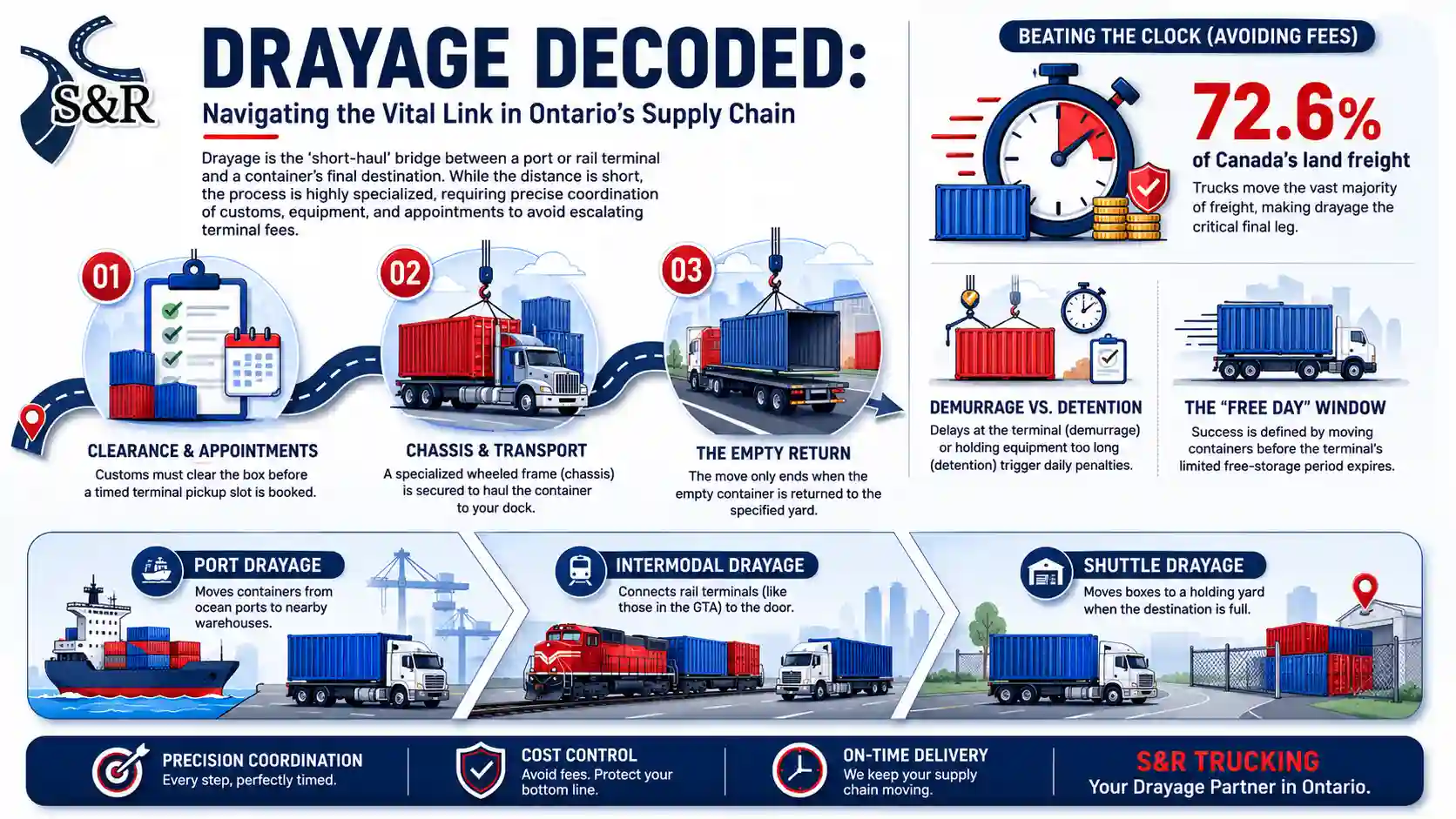
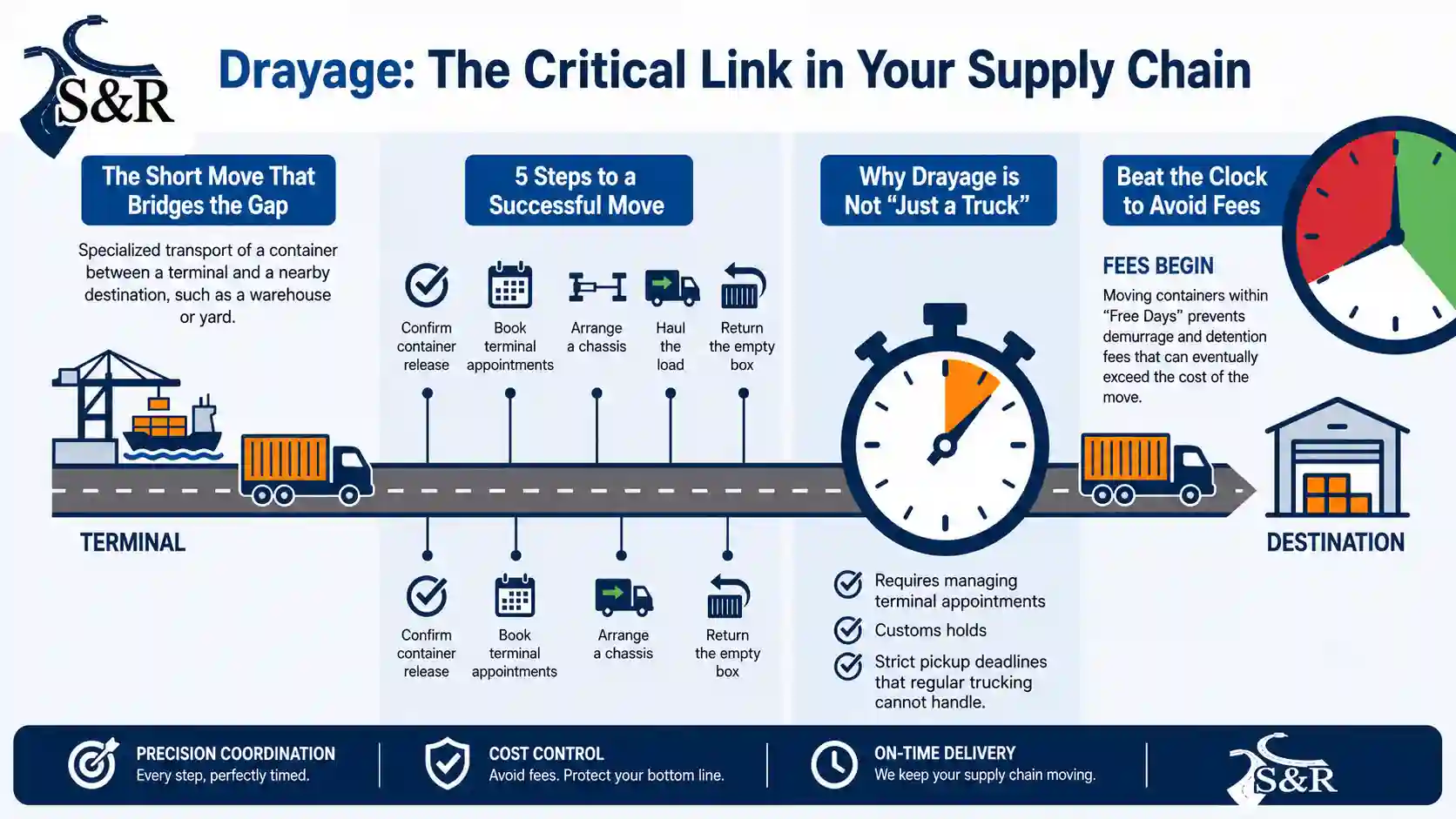
Drayage is the short-haul trucking of a shipping container between a port or rail terminal and a nearby destination, such as a warehouse, distribution centre, or your own yard. It’s a specialized service because it involves terminal appointments, chassis, customs holds, and strict pickup deadlines that regular trucking does not. Good drayage gets your container off the terminal before demurrage and detention fees start, which is why it matters far more than its short distance suggests.
What is drayage, exactly, and where did the word come from?
Drayage takes its name from a “dray,” an old word for a cart that hauled heavy loads a short distance. That’s still what it means today. Drayage is not the long-haul move across provinces. It’s the first or last short leg, usually within the same city or region, that connects the big transport modes to the ground.
When your container comes off a ship at the Port of Montreal or arrives by rail at a Toronto-area intermodal terminal, it can’t stay there. A drayage truck picks it up and moves it to wherever the freight needs to go next. That short trip is the whole job. So when someone asks what is drayage, the honest one-line answer is: the short move that bridges the terminal and your door.
Why does drayage even exist as its own service?
It exists because ports and rail terminals are not final destinations. They’re transfer points built to move containers on and off vessels and trains as fast as possible, not to store your freight. Somebody has to bridge the gap between the terminal and the real world, and that somebody is a drayage carrier.
The reason it’s a specialized service, and not just “a truck,” is everything wrapped around the move: booking a terminal appointment, sorting out the chassis the container rides on, clearing customs holds, and beating the pickup deadline before fees start. A regular dry-van carrier isn’t set up for any of that. Drayage services are.
How does a drayage move actually work, step by step?
Here’s what happens once your container is ready at the terminal:
The container is confirmed available. Customs has to be cleared and the ocean or rail carrier has to release the box before anyone can touch it.
A terminal appointment is booked. Most terminals now require a timed appointment to pick up, and slots fill quickly.
A chassis is arranged. The container needs a chassis, the wheeled frame it rides on. Who supplies it, and whether one is available, affects both timing and cost.
The drayage truck pulls the container. The driver checks in, collects the box, and hauls it to the destination.
The container is delivered and returned. After it’s unloaded, the empty container and chassis usually have to go back to a specified location, a move people forget to plan for.
Each of those steps has a deadline attached, and missing any one of them can trigger a fee. That’s why drayage is less about driving and more about coordination.
Good to know: the empty return leg is part of drayage too. If the empty container sits at your dock past the free period, detention fees start, so the job isn’t done until the box and chassis are back.
How S&R moves your container from terminal to door — port or rail pickup through final delivery.
What do you need ready before a drayage pickup?
A drayage move only goes smoothly when a few things are lined up before the truck rolls. Have these sorted early:
Customs clearance. The container can’t be released until it’s cleared, so file early.
The delivery site and appointment. Confirm the receiver can take the container in the window you’re targeting.
Chassis arrangements. Know whose chassis you’re using and that one is available.
Free-day awareness. Know your last free day at the terminal so you don’t drift into demurrage.
An unloading plan and empty return. Decide where the empty container and chassis go once it’s unloaded.
Getting these in place before the container lands is what separates a clean, single-fee drayage move from a week of daily charges. A good drayage carrier walks you through this checklist instead of waiting for a problem to surface.
What are the different types of drayage?
Not every drayage move looks the same. The common ones you’ll run into are:
Port drayage: moving a container from an ocean port to a nearby yard or warehouse.
Intermodal drayage: the truck leg that connects a rail terminal to the door, pairing with container transportation by rail.
Shuttle drayage: moving containers a short hop to a holding yard when the destination isn’t ready.
Expedited drayage: a rush move when a container has to clear the terminal before a deadline.
Most Ontario importers use a mix, often port or intermodal drayage from Montreal or a GTA terminal, sometimes with a shuttle to a nearby yard when a warehouse is full.
What makes drayage complex, and where does the real risk lie?
Drayage isn’t just a matter of moving a container from the terminal to the door. The true complexity comes from the terminal’s appointment system, chassis availability, the round-trip requirements including the empty return, fuel considerations, and any operational factors such as wait time, customs exams, or the need for a pre-pull.
But the biggest risk in drayage isn’t the move itself — it’s what happens when the container isn’t handled on time. Delays at the terminal, missed appointments, or slow carrier response can lead to cascading operational issues that disrupt your supply chain and create avoidable stress.
This is why working with an experienced drayage partner matters. A knowledgeable team can help you navigate terminal rules, avoid unnecessary delays, and ensure your container stays on schedule. Speaking with experts like S&R Trucking gives you clarity on what your move actually requires, how to plan around terminal constraints, and how to prevent the operational pitfalls that catch many shippers off guard.
Why does drayage matter so much for avoiding demurrage?
Because the clock starts the moment your container is available, and it doesn’t care whether you’re ready. Ports give you a limited number of free days to collect the box, and rail terminals do the same. After that, demurrage (fees for a container sitting at the terminal) and detention (fees for holding the container or chassis too long once you have it) start adding up daily.
A drayage carrier that knows the terminals, books appointments early, and plans the empty return is what keeps you inside those free windows. In 2024 the US Federal Maritime Commission even introduced new billing rules requiring clearer demurrage and detention invoices, a sign of how big a pain point these fees have become. Good drayage is the difference between a clean handoff and a bill full of penalties.
How does S&R handle drayage in Ontario?
S&R Trucking manages drayage across Ontario from our Kleinburg base on Highway 50, serving the GTA and pulling containers from the Port of Montreal and Toronto-area intermodal terminals. With more than three decades in the intermodal network, our team understands the terminals, appointment systems, and operational deadlines that determine whether a drayage move stays on track.
Because S&R also provides container transportation, container storage and solutions, and full truckload service under one roof, your container can move from the terminal to storage to final delivery without switching carriers. That continuity is essential when a warehouse isn’t ready, a container needs to be held, or cross-border requirements must be met. With trucks moving the majority of Canada’s land freight and US-bound containers needing to meet FMCSA rules, having one experienced carrier manage the entire ground leg keeps your operation simple and predictable.
If you have containers landing in Ontario, connect with S&R Trucking for a free consultation. Our experts will review your timeline, walk you through terminal requirements, and help you build a reliable plan that keeps your containers moving without disruption. Reach out today and let our team guide your next move with confidence.
Drayage is the short-distance trucking of a shipping container between a port or rail terminal and a nearby destination like a warehouse or yard. It’s the first or last leg of a container’s journey, not the long haul. The move is short, but it involves terminal appointments, chassis, and strict deadlines, which is why it’s a specialized service.
What is the difference between drayage and regular trucking?
Regular trucking moves freight over longer distances, often dock to dock. Drayage moves a container a short distance to or from a terminal and deals with everything that comes with it: appointments, chassis, customs holds, and free-time deadlines. A standard dry-van carrier isn’t set up for terminal work, while a drayage carrier is.
What is intermodal drayage?
Intermodal drayage is the truck leg that connects a rail terminal to the final destination. Your container travels most of the distance by rail, then a drayage truck picks it up at the terminal and delivers it to the door. It pairs road and rail to combine rail’s cost efficiency with a truck’s flexibility.
How do I avoid demurrage and detention fees?
Work with a drayage carrier that books terminal appointments early, tracks your container’s availability and free days, and plans the empty return. Have your customs clearance and delivery site ready before the container lands. The faster the box moves off the terminal and the chassis goes back, the less exposure you have to daily fees.
About S&R Trucking
This guide was written and reviewed by the team at S&R Trucking Inc, an Ontario freight carrier based at 10481 Highway 50 in Kleinburg, ON and part of an intermodal network since 1992. S&R handles drayage, container transportation, container storage, LTL, partial, flatbed, and full truckload freight across Ontario and into the US, so the guidance here comes from people who pull containers off these terminals every day. Have a container to move? Call 905-951-2951 or request a quote.
Sources: Statistics Canada: Transportation data; US Federal Maritime Commission: demurrage and detention; Container xChange: demurrage and detention charges; Ontario Trucking Association.
S&R Trucking Team
Since 1992, S&R Trucking has been one of Ontario's leading intermodal carriers, combining FTL, LTL, drayage, flatbed and secure storage with 24/7 dispatch across Canada and North America.
Ready to Move Your Freight?
Talk to a real dispatcher today and get a free, no-obligation quote for your next shipment.
Since 1992, S&R Trucking has been one of Ontario's leading intermodal carriers, combining FTL, LTL, drayage, flatbed and secure storage with 24/7 dispatch across Canada and North America.
Ready to Move Your Freight?
Talk to a real dispatcher today and get a free, no-obligation quote for your next shipment.
 July 11, 2026 - By : S&R Trucking Team

Leave a comment