If you’ve ever waited for a container that “should have been ready yesterday,” you already know how painful drayage delays can be. You’ve probably lived that exact situation: watching demurrage climb, drivers waiting in a terminal queue, the warehouse scrambling, and a customer asking, “Where’s my shipment?” It’s frustrating, it’s expensive, and the worst part is that most of it is avoidable with the right setup.
Here’s how drayage delays quietly drain money from your supply chain, why they keep happening, and what actually fixes them.
Drayage delays cost you money because every extra day a container sits at a port or rail terminal adds up, in demurrage, detention, missed appointments, driver wait time, and disrupted inventory. Most of these delays trace to predictable causes: late container availability, chassis shortages, paperwork errors, terminal congestion, and poor coordination with the warehouse. You avoid them by pre-booking pickups, using a carrier with real yard storage, keeping documentation clean, and working with a partner who has actual capacity, not just promises.
Why do drayage delays keep happening?
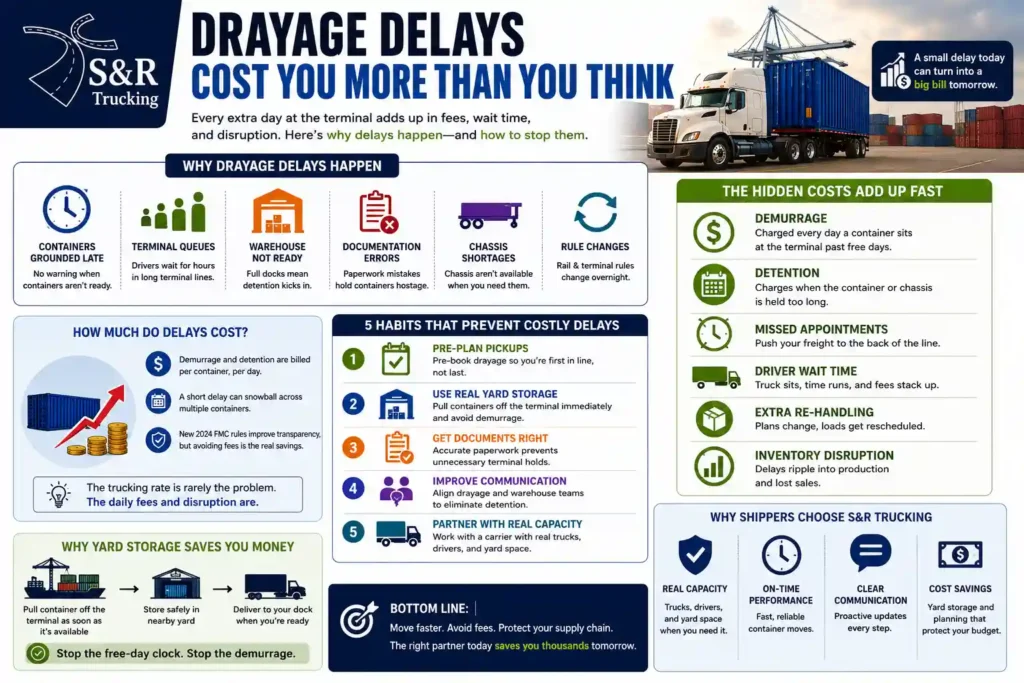
If you’ve dealt with any of these, you’re not alone. The same handful of problems show up again and again for importers:
- Containers grounded late with no warning
- Drivers stuck in terminal queues for hours
- Warehouses calling because they’re full and can’t unload
- Documentation errors holding a container hostage
- Chassis shortages that appear out of nowhere
- Rail terminals changing empty-return rules overnight
These aren’t rare events. They’re the everyday reality of moving containers through busy ports and rail terminals. The reason they feel so familiar is that the system has a lot of moving parts, and any one of them slipping stalls the whole move. Recognizing the pattern is the first step to breaking it.
What are the hidden costs you feel immediately?
When drayage breaks down, the costs hit fast and from several directions at once:
- Demurrage that grows every day a container sits at the terminal past its free days.
- Detention when the container or chassis is held too long because the warehouse wasn’t ready.
- Missed delivery appointments that push freight to the back of the queue.
- Driver wait-time charges while a truck sits in a terminal line.
- Extra re-handling and rescheduling every time a plan falls apart.
- Inventory delays that ripple into production or lost sales.
If you’ve ever opened an invoice and thought, “How did this get so high?”, drayage delays were probably the reason. The rate to move the container is rarely the problem. The fees that pile up when it doesn’t move on time are.
How much do drayage delays really cost you?
More than most shippers realize, because the fees compound. Demurrage runs while a container sits at the terminal, and detention runs once you have the box but hold it, or the chassis, too long. Both are billed per container, per day, so a short delay early can snowball across a fleet of boxes into a serious number.
These charges have become enough of a pain point that regulators stepped in. In 2024 the US Federal Maritime Commission introduced
new billing rules requiring carriers and terminals to explain demurrage and detention charges more clearly. Better transparency helps, but it doesn’t lower the bill. Avoiding the fees in the first place is the only real savings, and that comes down to how fast your container clears the terminal.
Good to know: the cost of a drayage delay is almost never the trucking rate. It’s the daily fees, the wait time, and the downstream disruption, which is exactly why moving the container faster saves far more than shaving a few dollars off the move.
How do you avoid the delays you’ve already experienced?
After years in this industry, the fixes that actually work are consistent. Five habits prevent most of the delays that cost you money:
- Pre-plan container pickups. Don’t wait for the terminal to tell you a container is ready. Have drayage pre-booked so you’re first in line, not last.
- Use a carrier with real yard storage. This is the single biggest money-saver. Yard storage lets you pull a container off the terminal immediately and avoid demurrage, even when your warehouse is full.
- Fix documentation accuracy. Most “unexpected” terminal delays are caused by paperwork errors. Getting the documents right saves days.
- Improve communication between drayage and warehouse teams. When everyone knows what’s arriving and when, detention largely disappears.
- Work with a partner who has real capacity. Not promises, but actual trucks, actual drivers, and actual yard space.
None of these are complicated. Together, with the right carrier, they remove the delays that quietly drain your budget.
Why is yard storage the single biggest money-saver?
Because it breaks the link between the terminal clock and your warehouse schedule. The most expensive delays happen when a container is ready but your dock isn’t. Left at the terminal, that box racks up demurrage every day. With real yard storage, the container gets pulled the moment it’s available and held nearby until you’re ready for it, so the free-day clock stops working against you.
This is where capacity matters. S&R Trucking operates 75 acres of yard storage, which means containers never have to sit at a terminal waiting for warehouse space to open up. When a box can be pulled and held on our own yard, the demurrage that would otherwise accrue simply doesn’t. Pair that with
container storage and solutions and
container transportation under one roof, and a container that can’t go straight to your dock still keeps moving off the terminal on time.
How does S&R eliminate the delays you’ve already felt?
Everything we do is built around the problems we’ve watched importers deal with for years. Our service is designed to remove them, not just react to them:
- Fast, reliable port and rail drayage that clears containers before the free days run out.
- 75 acres of yard storage so containers never have to sit at a terminal.
- Real-time updates so you’re never guessing where your box is.
- Cross-border drayage expertise for US and Canada freight, handled to FMCSA requirements.
- A dispatch team that knows port and rail operations inside out.
- Cost-saving strategies aimed squarely at eliminating demurrage and detention.
Trucks move roughly 72.6% of Canada’s land freight, according to
Statistics Canada, and that ground leg is exactly where delays turn into fees. We’ve been through the same frustrations you have, and we built our drayage service to eliminate them.
How do you know if drayage delays are quietly costing you?
Sometimes drayage delays are obvious, a container stuck for a week. More often they hide inside “normal” operations, a day here, a rebooked appointment there, until the fees add up at month-end. A few signs suggest drayage delays are draining more than you think.
Watch for recurring demurrage or detention lines on your invoices, containers that routinely clear on or after the last free day, drivers reporting long terminal waits, and warehouse teams constantly rescheduling receiving. Any of these means the ground leg isn’t keeping pace with the terminal clock.
The fix starts with visibility. A drayage performance review looks at your recent moves, finds where the delays and fees are concentrated, and pinpoints the causes, whether that’s late booking, chassis gaps, documentation, or a warehouse bottleneck. Once you can see where drayage delays are happening, most of them are straightforward to design out. What gets measured gets fixed, and drayage delays are no exception.
Ready to stop paying for drayage delays?
If you’ve ever been hit with demurrage, detention, or “unexpected delays,” let’s fix that for good. Request a drayage performance review and we’ll show you exactly where the delays are happening in your lanes, and how to eliminate them.
Call S&R Trucking at 905-951-2951 or
request a quote, and we’ll build a custom plan around your container volume, your terminals, and your warehouse schedule.
Frequently Asked Questions
What causes most drayage delays?
Most drayage delays come from a short list of predictable causes: containers grounded late with no warning, chassis shortages, documentation errors, terminal congestion, and poor coordination between the drayage carrier and the warehouse. Some are outside your control, but pre-booking pickups, keeping paperwork clean, and using a carrier with real capacity prevents the majority of them.
How do drayage delays cost me money?
They cost you through demurrage while a container sits at the terminal, detention when the box or chassis is held too long, driver wait-time charges, missed delivery appointments, re-handling, and inventory disruption. These fees are billed per container per day, so they add up fast. The trucking rate is rarely the issue; the delay fees are.
How can I avoid demurrage and detention?
Pre-book your container pickups so you’re first in line, keep documentation accurate so nothing is held at the terminal, coordinate closely with your warehouse, and use a carrier with real yard storage that can pull a container off the terminal immediately. Clearing the box before the free days run out is what keeps the fees from ever starting.
Why does yard storage save money on drayage?
Because it lets you pull a container off the terminal the moment it’s available, even when your warehouse is full, instead of leaving it to accrue demurrage. The container is held on the carrier’s yard until you’re ready. With 75 acres of yard storage, S&R can keep containers moving off terminals on time, which is the single biggest lever for avoiding fees.
How much does drayage cost?
There’s no flat rate, because it depends on your container size, the terminal, the distance, the chassis, and any accessorials, so the best way to know is a custom quote for your specific move. The bigger cost to manage is demurrage and detention, which fast, well-coordinated drayage and yard storage are designed to prevent.
About S&R Trucking
This guide was written and reviewed by the team at S&R Trucking Inc, an Ontario freight carrier based at 10481 Highway 50 in Kleinburg, ON and part of an intermodal network since 1992. S&R runs port and rail drayage, container transportation, and 75 acres of yard storage across Ontario and into the US, so the guidance here comes from people who fight terminal delays and demurrage every day. Tired of surprise fees? Call 905-951-2951 or
request a quote.
Sources: US Federal Maritime Commission: demurrage and detention; Statistics Canada: Transportation data; Ontario Trucking Association
S&R Trucking TeamSince 1992, S&R Trucking has been one of Ontario's leading intermodal carriers, combining FTL, LTL, drayage, flatbed and secure storage with 24/7 dispatch across Canada and North America.
Ready to Move Your Freight?
Talk to a real dispatcher today and get a free, no-obligation quote for your next shipment.
REQUEST A FREE QUOTES&R Trucking TeamSince 1992, S&R Trucking has been one of Ontario's leading intermodal carriers, combining FTL, LTL, drayage, flatbed and secure storage with 24/7 dispatch across Canada and North America.
Ready to Move Your Freight?
Talk to a real dispatcher today and get a free, no-obligation quote for your next shipment.
REQUEST A FREE QUOTE
 July 17, 2026 - By : S&R Trucking Team

Leave a comment