Rail intermodal transportation and over-the-road trucking serve the same purpose but behave very differently on the lanes where they compete. For an Ontario shipper moving freight to Montreal, Calgary, or Vancouver, the right choice between the two depends on four things: cost, speed, reliability, and how much transit variance your operation can absorb. Getting that comparison wrong in either direction costs money.
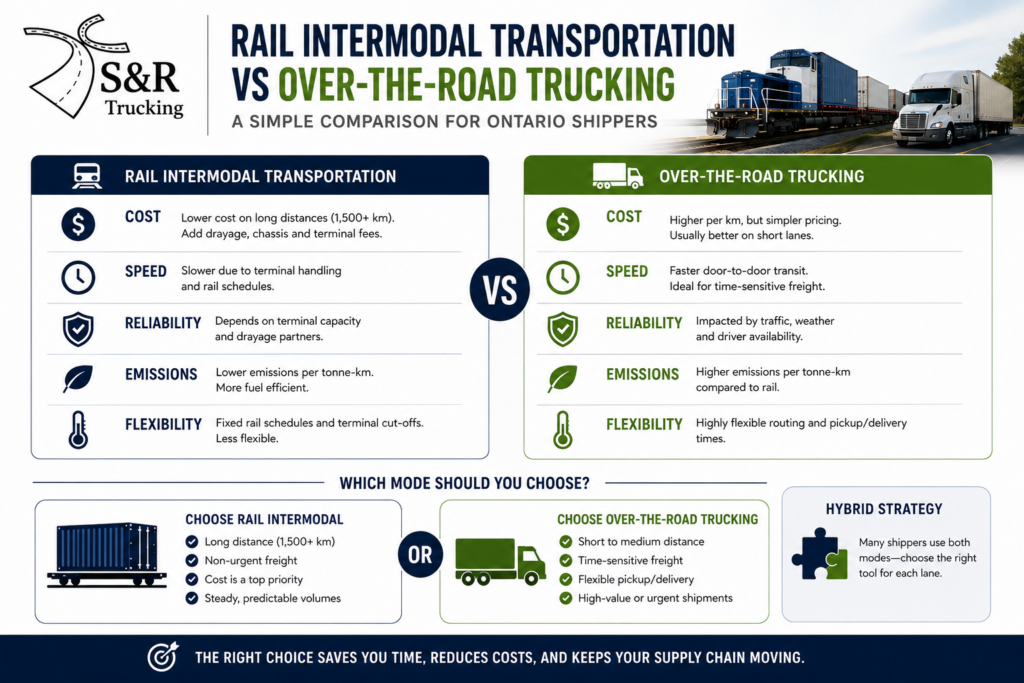
Rail intermodal transportation moves a container by train for the long-haul portion of a journey, with truck legs at each end. Over-the-road trucking uses one truck, door to door, for the entire move. Rail intermodal typically costs less on corridors of 1,500 kilometres or more with non-urgent freight, while OTR trucking is faster, more flexible, and simpler to coordinate on shorter or time-sensitive lanes. Neither mode wins across the board. The right choice is a per-lane decision, not a company-wide policy.
What Makes Rail Intermodal Transportation Different
Over-the-road trucking is direct: one driver and one trailer pick up your freight and drive it to the destination. The route is flexible, the schedule is yours, and there is one point of contact from start to finish. Rail intermodal transportation splits the move into three legs. A
drayage carrier delivers the loaded container to a CN or CP intermodal terminal. The train carries it over the main corridor, which might be Toronto to Montreal, Toronto to Calgary, or a cross-border lane into the US. A second drayage carrier collects the container from the destination terminal and delivers it to the consignee. That structure drives every difference in the comparison below. Rail intermodal transportation adds complexity in exchange for fuel efficiency over distance. OTR trucking gives you simplicity and speed at a higher per-kilometre cost.
Cost: Where Rail Has the Advantage and Where It Loses It
A train moves a ton of freight far more efficiently per litre of fuel than a long-haul truck. That efficiency compounds over distance and shows up as a lower lane rate. On corridors of 1,500 kilometres or more, rail intermodal transportation is usually cheaper per container than a dedicated OTR truckload. The catch is that rail intermodal’s total cost includes more than the rail rate. Origin drayage, destination drayage, chassis fees at both terminals, and terminal handling surcharges all add to the bill. On short corridors, those add-ons are enough to close the gap with OTR, or exceed it entirely.
Good to know: Before comparing modes on cost, build the full intermodal number: rail rate + origin drayage + destination drayage + chassis fees at both terminals. Compare that against a direct OTR quote. On Ontario-Quebec lanes, the savings can be meaningful. On lanes under 800 km, OTR often wins on total cost.
Speed and Transit Time: The Real Numbers by Corridor
Over-the-road trucking is faster, and the gap is meaningful on most Ontario lanes. A direct truckload from Toronto to Montreal can run overnight. Toronto to Calgary by truck typically takes three to four days with a team driver. Rail intermodal transportation adds time in two places: the terminal legs at each end, and the rail transit itself, which runs on the railroad’s timetable rather than yours. Here are rough door-to-door timelines for common Ontario corridors:
| Corridor |
Rail Intermodal (door-to-door) |
OTR Trucking (door-to-door) |
| Toronto to Montreal |
3–4 days |
1–2 days |
| Toronto to Calgary |
6–8 days |
3–4 days |
| Toronto to Vancouver |
7–9 days |
4–5 days |
| Toronto to Chicago (cross-border) |
4–5 days |
2–3 days |
These are general estimates. Actual transit times vary with rail schedule, terminal congestion, and driver availability. For freight with a fixed delivery deadline, the transit variance in rail intermodal transportation is the more relevant figure than the average time.
Reliability: How Each Mode Fails
Both modes are reliable when matched to the right freight. They fail in different ways, and knowing which failure mode applies to your operation matters more than debating which mode is more reliable in the abstract. OTR trucking failures typically come down to driver availability, traffic delays, and weather on the highway. A single truck breakdown affects your entire shipment. Finding a replacement truck on short notice, especially on a long-haul lane, can add a full day or more. Rail intermodal failures tend to come from terminal congestion, ramp cutoff misses, and weak drayage at the destination end. A container that transits flawlessly by rail can still sit at the destination terminal for an extra day if the drayage carrier has chassis availability issues or cannot get a gate appointment. The reliability lever for rail intermodal transportation is the drayage quality at each end. Our
drayage services keep that leg coordinated, with chassis arranged in advance, gate appointments booked, and free-time windows tracked so containers do not sit uncollected.
Emissions: The One Area Where Rail Consistently Wins
For shippers tracking freight emissions, rail intermodal transportation has a clear structural advantage. A freight train moves a container far more efficiently per tonne-kilometre than a long-haul truck, and that difference shows up in emissions per unit of freight moved. If reducing your supply chain’s carbon footprint is a reporting or procurement requirement, shifting high-volume, long-haul lanes to rail intermodal is one of the most straightforward ways to do it without reducing service levels. The truck legs at each end still generate emissions, but the net impact is lower than a full OTR move on the same corridor.
Rail Intermodal vs OTR Trucking: Full Comparison
| Factor |
Rail Intermodal Transportation |
Over-the-Road Trucking |
| Cost on long corridors |
Lower (rail efficiency) |
Higher (full truck cost) |
| Cost on short corridors |
Often higher all-in |
Lower |
| Transit time |
Longer (1–3 days added) |
Shorter, more consistent |
| Transit reliability |
Subject to congestion/weather |
Higher on direct lanes |
| Flexibility / rerouting |
Lower |
High |
| Emissions per tonne-km |
Much lower |
Higher |
| Temperature control |
Not standard |
Available (reefer trailer) |
| Ideal freight |
Non-urgent, long-haul, high-volume |
Any, including time-sensitive |
Using Both Modes: Rail Intermodal and Trucking as a Portfolio
Most efficient shipping operations do not choose one mode permanently. They treat mode as a per-lane decision: rail intermodal transportation for the long, steady, cost-sensitive corridors, and OTR trucking for short, urgent, or highly variable lanes. The practical requirement for running a hybrid network is a carrier who operates both. A carrier who only sells trucking will recommend trucking. A carrier who only sells intermodal will recommend rail. What you want is a carrier who runs both and can give you a straight cost comparison on your specific lane, along with the coordinated hand-offs when a shipment uses rail plus truck in sequence. S&R Trucking has been part of an intermodal network since 1992. Our
container transportation services cover both container moves that connect to rail intermodal corridors and direct OTR container transport when rail does not fit the timeline or lane. You get a comparison based on your actual freight, not on which service a dispatcher happens to have capacity in this week. If your lane is short and urgent, our
full truckload service covers that end of the portfolio directly. Call 905-951-2951 or visit
srtrucking.ca/contact/ to compare rail intermodal and trucking on your specific lanes.
Key Takeaways
- Rail intermodal transportation moves a container by train for the long-haul leg, with truck drayage at each end. Over-the-road trucking runs one truck door to door for the entire move.
- Rail intermodal costs less on corridors of 1,500 km or more, where train fuel efficiency outweighs the added drayage fees at both terminals.
- On shorter Ontario lanes under 800 km, the all-in intermodal cost often matches or exceeds a direct OTR quote once drayage, chassis, and terminal handling are included.
- OTR trucking is one to three days faster than rail intermodal on most Canadian corridors, with less transit variance and easier rerouting if problems arise.
- Rail intermodal reliability depends heavily on the drayage quality at each end. A smooth rail transit can fail at the destination terminal if drayage is disorganized.
- Rail intermodal transportation has significantly lower emissions per tonne-kilometre than OTR trucking, making it a better fit for shippers with sustainability reporting requirements.
- Most efficient shipping operations use both modes: rail for long, steady, cost-sensitive lanes and trucking for short, urgent, or variable freight.
- S&R Trucking operates both rail intermodal and OTR services from Kleinburg, ON, and can compare both options on your specific lanes.
Frequently Asked Questions
What is rail intermodal transportation?
Rail intermodal transportation is the movement of a shipping container by freight train for the long-haul portion of a journey, with truck drayage connecting the origin to the departure terminal and the destination terminal to the consignee. In Ontario, this typically involves CN or CP rail and terminals such as the Vaughan Intermodal Terminal for GTA-area freight.
Is rail intermodal transportation cheaper than trucking?
On long corridors of 1,500 kilometres or more with non-urgent freight, rail intermodal transportation is usually cheaper. The rail rate itself is lower due to fuel efficiency, but the total cost must include origin drayage, destination drayage, and chassis fees at both terminals. On shorter Ontario lanes, the all-in intermodal cost often matches or exceeds a direct OTR quote.
Which is faster, rail intermodal or over-the-road trucking?
Over-the-road trucking is faster on most corridors. Toronto to Montreal by truck typically runs one to two days; by rail intermodal the door-to-door time is closer to three to four days. On longer lanes like Toronto to Vancouver, rail intermodal adds two to four days compared to OTR. For time-sensitive freight, OTR is the more reliable choice.
How does rail intermodal affect freight emissions?
Rail intermodal transportation produces significantly lower emissions per tonne-kilometre than over-the-road trucking, because freight trains are far more fuel-efficient over long distances. For shippers with sustainability reporting requirements, shifting long-haul lanes to rail intermodal is one of the most practical ways to reduce supply chain emissions without cutting service.
Can a shipper use both rail intermodal and OTR trucking?
Yes, and most efficient operations do. The standard approach is to assign each lane to the mode that fits its distance, timing, and budget: rail intermodal transportation for long, high-volume, non-urgent corridors and OTR trucking for short, urgent, or variable shipments. A carrier who operates both modes can manage the coordination and give you a straight cost comparison without a conflict of interest.
Does S&R Trucking offer both rail intermodal and OTR trucking services?
Yes. S&R Trucking has been part of Ontario’s intermodal network since 1992 and handles both container transportation connected to rail intermodal corridors and direct OTR moves when rail does not fit the lane. We can compare both options on your specific freight and manage the drayage legs when rail is involved. This guide was written and reviewed by the team at S&R Trucking Inc, an Ontario freight carrier based at 10481 Highway 50 in Kleinburg, ON and part of an intermodal network since 1992. S&R moves freight by rail intermodal transportation, container transportation, and drayage, along with LTL, partial, flatbed, and full truckload service across Ontario and into the US, so the guidance here comes from people who run both modes every day. Comparing modes on your lane? Call 905-951-2951 or
request a quote. Sources:
Association of American Railroads: Freight Rail Facts and Figures;
Statistics Canada: Transportation data;
Ontario Trucking Association.
S&R Trucking TeamSince 1992, S&R Trucking has been one of Ontario's leading intermodal carriers, combining FTL, LTL, drayage, flatbed and secure storage with 24/7 dispatch across Canada and North America.
Ready to Move Your Freight?
Talk to a real dispatcher today and get a free, no-obligation quote for your next shipment.
REQUEST A FREE QUOTES&R Trucking TeamSince 1992, S&R Trucking has been one of Ontario's leading intermodal carriers, combining FTL, LTL, drayage, flatbed and secure storage with 24/7 dispatch across Canada and North America.
Ready to Move Your Freight?
Talk to a real dispatcher today and get a free, no-obligation quote for your next shipment.
REQUEST A FREE QUOTE
 July 31, 2026 - By : S&R Trucking Team

Leave a comment