Choosing a drayage company in Toronto is one of those decisions that feels simple until it goes wrong. Most importers running regular GTA container volumes have a version of the same story: a carrier that missed the appointment window, a broker who could not reach the driver, a container that sat four extra days and ran up demurrage fees that erased the margin on the shipment. The questions that prevent those situations take about twenty minutes to ask. Most importers never ask them before signing a rate agreement.
A reliable drayage company in Toronto should have established appointment access at the GTA intermodal terminals your containers use, in-house drivers rather than brokered capacity, and a dispatch team that tracks container status proactively rather than waiting for you to call. For importers handling regular container volumes in the GTA, the drayage carrier’s terminal relationships and dispatch structure matter more than the base rate on the quote.
Why the Drayage Company You Choose in Toronto Matters More Than the Rate
Container drayage in Toronto looks like a commodity service until you are watching demurrage accumulate on a container nobody can reach. The base rate per move is almost always within a few dollars between carriers. What varies significantly is how each carrier performs when the appointment window fills, the chassis pool runs short, or the terminal changes its gate hours with a day’s notice.
The cost of one missed appointment window in the GTA, combined with a day or two of demurrage, typically exceeds the annual rate savings from choosing the cheapest carrier over a reliable one. For importers moving more than a handful of containers a month, the drayage company’s operational structure is a cost factor, not just a service preference.
The questions below are designed to surface the difference between a drayage company that will perform reliably over time and one that looks fine on paper until it does not.
Good to know: Drayage rates in the GTA usually include a base move charge plus fuel surcharge, chassis fees, and any per diem or detention charges. Ask for a complete rate card, not just the base move rate, before comparing quotes from different container drayage companies in Toronto.
Seven Questions to Ask Any Drayage Company in Toronto Before Committing
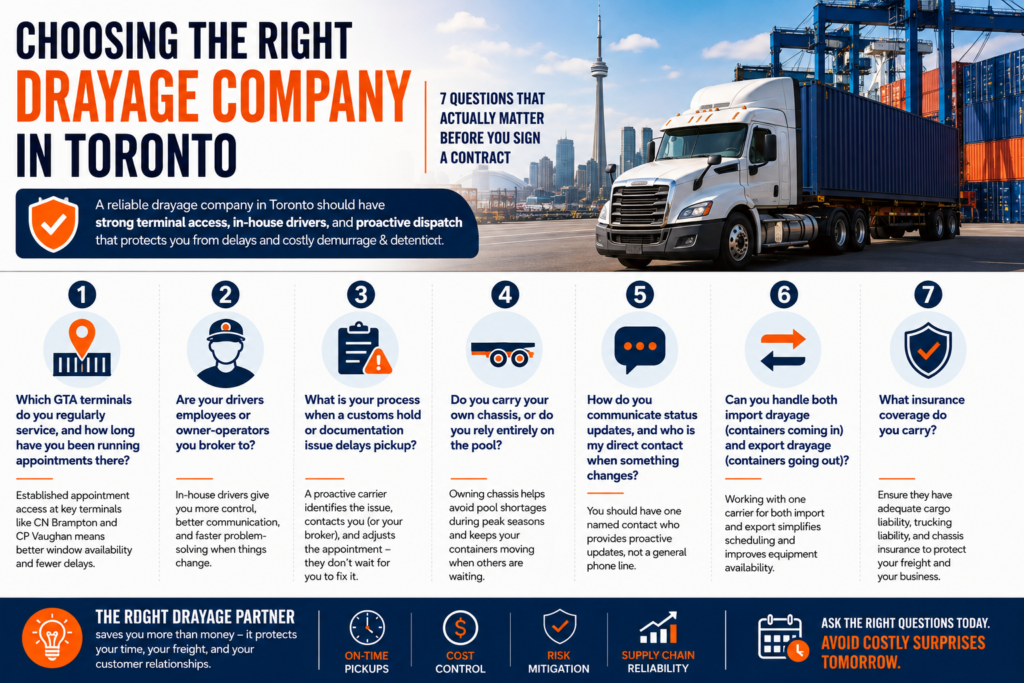
Run through these with any drayage carrier you are evaluating for your GTA container lanes. The answers tell you far more than the rate sheet.
1. Which GTA terminals do you regularly service, and how long have you been running appointments there?
Terminal appointment access is not automatic and is not equal across carriers. A drayage company with a long appointment history at a specific terminal gets better window availability than one that is newer to the system. Ask for the specific terminals, not a general claim that they cover all of them. If your containers arrive at the CN Brampton terminal, confirm that is where they have consistent access, not just the CP Vaughan facility.
2. Are your drivers employees or owner-operators you broker to?
This single question tells you how much control the drayage company actually has over its own capacity. A carrier with in-house drivers can dispatch, re-route, and communicate directly when conditions change at the terminal. When capacity is brokered, there is an extra layer between you and the truck, and that layer slows everything down at exactly the moments when speed matters most.
3. What is your process when a customs hold or documentation issue delays pickup?
A good drayage company in Toronto has a clear protocol: they identify the hold, contact the importer or customs broker immediately, confirm when clearance is expected, and adjust the appointment accordingly. A weaker carrier calls you with the problem and waits for you to solve it. Ask specifically what steps they take and who owns the resolution process on their end.
4. Do you carry your own chassis, or do you rely entirely on the pool?
Chassis pool shortages hit GTA terminals predictably during the October-December peak import season and again in early spring. A drayage company that carries at least some of its own chassis can often pick up a container when competitors are stuck waiting for pool availability. A carrier that depends entirely on the shared pool has limited options during a shortage and limited leverage to offer you.
5. How do you communicate status updates, and who is my direct contact when something changes?
One named contact matters. A drayage company that gives you a general phone line and no specific account owner for your freight is telling you something about how your file will be handled. Ask how they communicate when the terminal delays the appointment, when a customs hold comes in, or when a driver runs into gate access problems. Proactive communication versus reactive communication is the clearest indicator of how a drayage carrier performs under pressure.
6. Can you handle both import drayage (containers coming in) and export drayage (containers going out)?
If your operation involves both directions, a container drayage company in Toronto that handles both simplifies your logistics significantly. You get one carrier, one invoice, and a carrier that understands both your receiving flow and your outbound schedule. It also improves your negotiating position on rates, because volume in both directions makes your account more valuable to the carrier.
7. What is your free time policy, and what happens when a terminal delay pushes pickup past the free time window?
Some drayage companies pass all demurrage and detention charges to the importer regardless of the cause, including delays the carrier contributed to. Others build in a process for flagging free time expiry in advance and sharing accountability when the delay is on their side. Ask directly what happens when free time runs out due to a carrier-caused appointment miss. The answer reveals how the carrier handles shared accountability.
Red Flags to Watch for When Comparing Drayage Quotes in Toronto
Beyond the questions above, a few things in the quote or initial conversation signal a drayage company that will cause problems.
No rate transparency
A rate with no itemization of fuel surcharge, chassis fees, or per diem rules. A complete rate card shows all components. A single line number is a number that will change.
Vague terminal coverage
Vague coverage claims such as “we service all GTA terminals” without naming them. Ask for specifics. General claims often mean brokered access, not direct terminal relationships.
No named contact
No direct dispatch contact provided. If you cannot get a name and a direct number before the first shipment, assume you will be calling a general line when something goes wrong.
No customs hold protocol
A carrier who cannot clearly explain what happens when a customs hold delays a pickup. This process should be well-worn and automatic, not something the contact needs to figure out on the call.
Unusually low rates
Rates that look significantly lower than competitors without a clear explanation. Low rates in container drayage in Toronto often mean the capacity is brokered at a spread, the chassis is unbundled, or the carrier is new to GTA terminal operations.
What the Rate Agreement with a Toronto Drayage Company Should Actually Cover
Most drayage rate agreements in the GTA are relatively short, but there are specific items that should appear in writing before your first container moves.
| Item |
What to Confirm |
| Base move rate |
Per move, by container size (20-foot vs 40-foot); confirm whether overweight or high-cube containers carry a surcharge |
| Fuel surcharge |
How it is calculated (percentage vs flat fee); how often it updates; what index it tracks |
| Chassis fee |
Daily rate; whether it is included in the base or billed separately; what happens if the terminal creates a chassis delay |
| Free time definition |
How many free days are included; when the clock starts (discharge date vs available date) |
| Detention and per diem |
Who is responsible when the delay is the carrier’s and when it is the terminal’s; what the daily rate is |
| Notification requirement |
How quickly the carrier notifies you of a customs hold, appointment delay, or gate issue |
| Insurance coverage |
Carrier liability on the container while in their custody; whether your cargo insurance needs to cover the drayage leg separately |
You do not need a lengthy contract, but you do need these items documented. A drayage company in Toronto that resists putting these in writing is worth noting.
S&R Trucking as a Container Drayage Company Serving Toronto and the GTA
S&R Trucking is based in Kleinburg, Ontario, close to the Highway 400 and Highway 7 corridor, and has been part of an intermodal network since 1992. S&R provides
drayage services for importers running containers through the Port of Montreal corridor and GTA intermodal terminals, with in-house drivers dispatched directly and consistent appointment access at the terminals we regularly service.
For importers evaluating a drayage company in Toronto for their GTA container lanes, S&R handles the appointment coordination, monitors container status, and gives you a direct dispatch contact for your account. We quote on a full rate card, covering the base move, fuel, and chassis, so the number you see is the number you pay barring importer-side delays.
If you are running containers regularly through the GTA and want to talk through your lane before getting a formal quote, call S&R Trucking at 905-951-2951 or reach us through the
contact page. For context on what causes drayage delays and how to avoid them, see our breakdown of
container drayage delays and demurrage fees.
Key Takeaways
- The right drayage company in Toronto is not the cheapest one. It is the one whose terminal relationships, dispatch structure, and communication prevent the delays that cost more than the rate difference.
- Ask specifically which GTA terminals the carrier services, how long they have had appointment access there, and whether their drivers are in-house or brokered before committing.
- In-house drivers give the drayage company direct control over scheduling and communication. Brokered capacity adds a layer that slows response at the moments when speed matters most.
- Chassis access matters during peak import seasons (October-December and March-April). A carrier with its own chassis has options when the pool runs short.
- Free time runs from discharge date, not from when your clearance comes in. Know the deadline, and confirm your drayage carrier is booking the appointment before that window closes, not after.
- A complete rate card covers the base move, fuel surcharge, chassis fee, and per diem rules. A single quoted number without these components will change.
- Get the free time definition, detention policy, and customs hold notification process in writing before the first container moves.
- S&R Trucking serves GTA container lanes from Kleinburg, Ontario, with in-house dispatch, consistent GTA terminal access, and drayage experience as part of an intermodal network since 1992.
Frequently Asked Questions
What does a drayage company in Toronto do?
A drayage company in Toronto moves shipping containers between GTA intermodal rail terminals and final delivery addresses, such as warehouses and distribution centres across the Greater Toronto Area. The drayage carrier handles the road leg of an intermodal shipment, coordinating the terminal appointment, dispatching the truck, and managing the container from the terminal gate to the delivery point. Some drayage companies in Toronto also handle the repositioning of empty containers back to the terminal.
How do I find a reliable drayage company in Toronto?
Ask specific questions before committing: which GTA terminals they service and for how long, whether drivers are in-house or brokered, how they handle customs holds, and whether they carry their own chassis. Look for a carrier who gives you a named dispatch contact, provides a complete rate card, and explains their free time and detention policy clearly. A carrier who answers these questions specifically is operating with transparency. One who deflects or answers vaguely is worth looking at twice.
What is the difference between a drayage company and a freight broker?
A drayage company owns or directly employs the trucks that move your containers. A freight broker arranges the move by finding a carrier, adding a margin, and coordinating between you and the actual truck. In the GTA drayage market, some companies operate as both, meaning they use their own capacity for some moves and broker to other carriers for others. It matters because brokered capacity means one less layer of direct control when timing is critical. Ask your carrier directly how they handle your lane.
How much does a drayage company in Toronto charge?
Drayage rates in Toronto vary by terminal, delivery address, container size, and whether the chassis is included. A typical GTA drayage move includes a base rate plus fuel surcharge and chassis fee. Per diem or detention charges apply if the container is held at the terminal past free time or if the delivery appointment causes the driver to wait. Ask for a full rate card rather than a single number. S&R Trucking provides detailed quotes for GTA container drayage lanes. Call 905-951-2951 or visit
srtrucking.ca/contact/.
What GTA intermodal terminals do container drayage companies in Toronto service?
The main intermodal terminals used for container drayage in the GTA are the CN Brampton Intermodal Terminal and the CP Toronto Intermodal Terminal in Vaughan. Both terminals receive containers from the Port of Montreal corridor and Trans-Pacific rail moves via Vancouver and Prince Rupert. Not every drayage company has consistent appointment access at both facilities. Confirm which specific terminal your containers arrive at and ask the carrier to confirm their appointment history there.
Can a drayage company in Toronto handle both import and export containers?
Yes. Many container drayage companies in Toronto handle both inbound moves (picking up import containers from the terminal for delivery to your facility) and outbound moves (picking up empty or loaded containers from your facility and returning them to the terminal or a rail ramp). Handling both directions with the same carrier simplifies your coordination and can improve your rate, since the carrier can better use its trucks across both moves.
S&R Trucking TeamSince 1992, S&R Trucking has been one of Ontario's leading intermodal carriers, combining FTL, LTL, drayage, flatbed and secure storage with 24/7 dispatch across Canada and North America.
Ready to Move Your Freight?
Talk to a real dispatcher today and get a free, no-obligation quote for your next shipment.
REQUEST A FREE QUOTES&R Trucking TeamSince 1992, S&R Trucking has been one of Ontario's leading intermodal carriers, combining FTL, LTL, drayage, flatbed and secure storage with 24/7 dispatch across Canada and North America.
Ready to Move Your Freight?
Talk to a real dispatcher today and get a free, no-obligation quote for your next shipment.
REQUEST A FREE QUOTE
 August 10, 2026 - By : S&R Trucking Team

Leave a comment