When your container clears customs and is marked available, the
container drayage clock does not wait for anyone. Most importers assume the hard part is over once the ship docks, but the terminal leg is where delays pile up and demurrage fees start eating into your margins. Understanding what stalls container drayage at the terminal, and what you can do about it before your next vessel arrives, is the difference between a clean import cycle and an invoice you did not see coming.
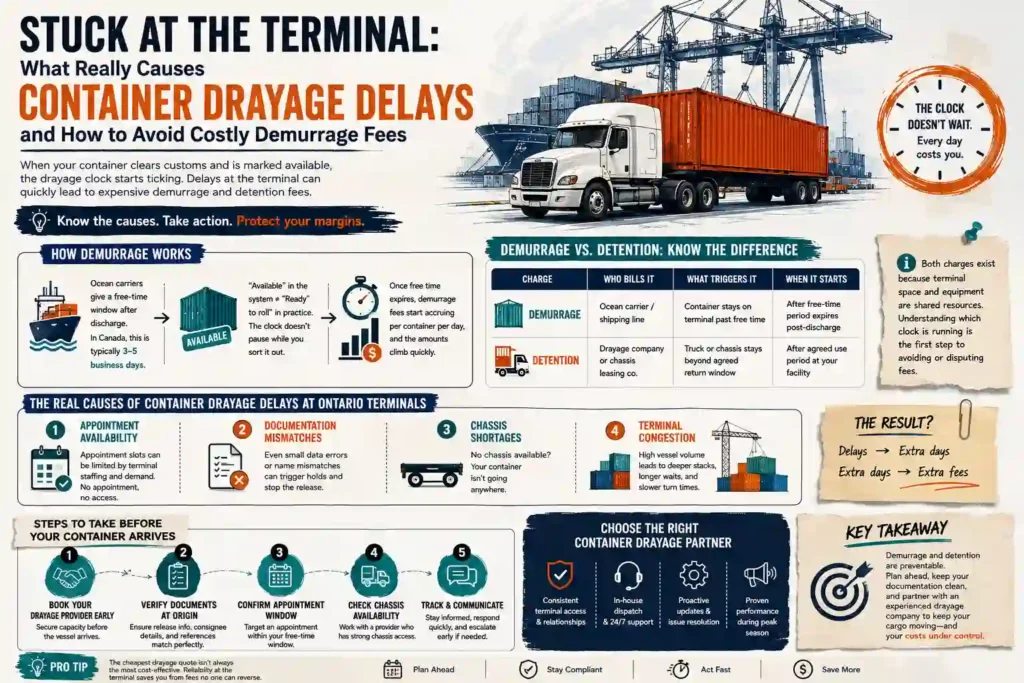
Container drayage delays happen when there is a gap between when your container is ready for pickup and when a truck can actually get it out of the terminal. The most common causes are trucker appointment shortages, documentation mismatches, chassis unavailability, and terminal congestion. You can limit your exposure by booking your drayage provider before the vessel arrives, confirming your paperwork is clean at origin, and working with a company that has consistent terminal access and an in-house dispatch team behind them.
How Demurrage Works, and Why the Clock Starts Before You Are Ready
Most ocean carriers give importers a free-time window after the container is discharged from the vessel. In Canada, free time at major terminals typically runs three to five business days. Once that window closes, demurrage fees start accruing per container per day, and the amounts climb quickly.
The problem is that “available” in the terminal’s system and “ready to roll” in practice are two different things. A container can sit in available status while your customs broker is still working through a hold, while a chassis is tied up elsewhere, or while appointment slots on the terminal’s booking system are fully booked. The clock does not pause while you sort it out.
Good to know: Demurrage is charged by the ocean carrier for keeping the container on the terminal past free time. Detention is charged for keeping the carrier’s equipment, the truck and chassis, beyond the agreed pickup and return window. They are different charges, billed by different parties, and both can appear on the same import.
Demurrage vs. Detention: Knowing the Difference Before the Bill Arrives
Shippers regularly confuse these two charges, and that confusion makes them harder to contest when something goes wrong.
| Charge |
Who Bills It |
What Triggers It |
When It Starts |
| Demurrage |
Ocean carrier / shipping line |
Container stays on terminal past free time |
After free-time period expires post-discharge |
| Detention |
Drayage company or chassis leasing co. |
Truck or chassis stays beyond agreed return window |
After agreed use period at your facility |
Both charges exist because terminal space and equipment are shared resources. Your drayage provider can help you track both timelines, but they cannot override the ocean carrier’s free-time policy. Knowing which clock is running on a given shipment is the first step to contesting a fee that was not your fault.
The Real Causes of Container Drayage Delays at Ontario Terminals
Generic articles blame “supply chain disruptions.” Here is what is actually happening on the ground.
Appointment availability
Ontario’s major intermodal terminals, including those handling Toronto-bound containers from the Port of Montreal corridor, run on appointment-based access systems. When slots are fully booked or limited by terminal staffing, your container drayage driver cannot get in regardless of how available the container shows in the system. This is one of the most consistent choke points during peak import periods.
Documentation mismatches
If the party name on the cargo release does not exactly match what is in the carrier’s system, or a customs hold gets flagged after arrival, the terminal will not release the container. Even minor data errors, a misplaced reference number, or a name abbreviation that differs from the manifest, can stall pickup for days. These errors typically originate at origin but show up at the terminal.
Chassis shortages
Container drayage requires a chassis to move the box out of the terminal. At busy periods, chassis pools run low. A driver can arrive with a valid appointment and clean documentation and still not get out because there is no chassis available. This is a structural issue at high-volume terminals and is beyond the direct control of any single drayage trucking company.
Terminal congestion
High vessel volume compresses terminal operations. Containers get stacked deeper, dwell times go up, and the whole facility slows down. This is a market-wide condition, but a container drayage company with consistent terminal volume and strong relationships can navigate it more effectively than an occasional broker.
Steps to Take Before Your Container Arrives
Taking the right steps before the vessel docks significantly reduces your exposure to demurrage fees. This is the practical sequence.
Step 1: Book your drayage provider before the ETA
Once you have the vessel booking confirmed, put your container drayage company on notice with the container number, the terminal, and your expected availability window. They can start monitoring and queue for appointment slots ahead of time.
Step 2: Confirm customs clearance timing with your broker
Establish when clearance is expected relative to arrival and build that into the pickup plan. A drayage provider monitoring your release can book the first available appointment slot right after clearance goes through.
Step 3: Audit your documentation for data accuracy at origin
The party names, HS codes, and reference numbers on your commercial invoice and packing list must match the carrier’s manifest exactly. A discrepancy triggers a customs hold, and a hold eats directly into your free-time window.
Step 4: Know your free-time period before the vessel departs
Different ocean carriers have different policies. Some give three business days, others five, and the definition of “business day” varies by terminal. Ask your freight forwarder to confirm it and include it in the arrival notice.
Step 5: Confirm your facility is ready to receive on delivery day
Delays happen on the delivery end too. If your warehouse cannot unload the container the day it arrives, detention charges start building at your facility instead of at the terminal.
How Your Container Drayage Company Changes the Outcome
Not all container drayage companies operate the same way. A drayage provider with consistent terminal volume gets priority access to appointment slots faster than an occasional player. A company with in-house dispatch, rather than a broker who subcontracts to whoever is available that day, can respond quickly when a documentation issue surfaces or an appointment slot opens unexpectedly.
For importers moving containers into Ontario and the GTA, working with a drayage company that also handles
container transportation means fewer hand-offs and better communication. The truck picking up your container at the terminal is part of the same network delivering it to your door, and information flows in both directions without the gaps that come from managing multiple vendors.
S&R Trucking: Ontario Container Drayage With In-House Dispatch
S&R Trucking has been part of an intermodal network since 1992 and provides
container drayage services out of Kleinburg, Ontario. When a container is available at a Toronto-area terminal or arrives through the Port of Montreal corridor, S&R’s dispatch team monitors the release and books terminal appointments directly. The coordination is internal, which means fewer gaps between “the container is available” and “the truck is moving.”
If your containers are sitting at the terminal and demurrage is running,
contact S&R Trucking at 905-951-2951 or request a quote. We will look at your terminal and lane and tell you what we can do.
Key Takeaways
- Container drayage delays happen when there is a gap between container availability and truck pickup, and demurrage fees accumulate during that gap.
- Demurrage (charged by the ocean carrier for terminal time) and detention (charged for equipment use beyond an agreed return window) are separate charges on separate invoices.
- The four most common causes of container drayage delays at Ontario terminals are appointment shortages, documentation mismatches, chassis unavailability, and terminal congestion.
- Booking your drayage provider before the vessel arrives is the single most effective step to protect your free-time window.
- Clean, accurate documentation at origin reduces the risk of customs holds that eat directly into free time at the terminal.
- A container drayage company with consistent terminal volume and in-house dispatch handles appointment issues faster than a broker outsourcing to available drivers.
- For Ontario importers, working with a drayage provider experienced at GTA intermodal terminals and the Port of Montreal corridor reduces the most common points of failure.
- If you are regularly seeing demurrage charges, audit your process sequence and your carrier relationship, not just the individual shipments.
Frequently Asked Questions
What is container drayage?
Container drayage is the short-distance truck movement of a shipping container from a port or intermodal terminal to its next destination, whether that is a warehouse, distribution centre, or rail facility. In Ontario, it most often covers pickup at Toronto-area intermodal terminals or from the Port of Montreal corridor and delivery to facilities across the GTA and surrounding regions.
What causes demurrage fees on import containers?
Demurrage fees are triggered when a container stays on the terminal past the ocean carrier’s free-time window, typically three to five business days after discharge and clearance for pickup. Common causes include trucker appointment shortages, customs holds, chassis unavailability, and terminal congestion that delays access even when a truck and appointment are ready.
How can I avoid demurrage fees on my containers?
Book your container drayage company as soon as you have the vessel ETA, confirm customs clearance timing with your broker in advance, and audit your documentation for accuracy before the vessel departs. These three steps catch most avoidable delays before the free-time clock starts running at the terminal.
What is the difference between demurrage and detention?
Demurrage is charged by the ocean carrier when your container sits on the terminal past free time. Detention is charged when a container or chassis stays at your facility beyond the agreed return window. Both can appear on the same import but come from different parties and are calculated differently. Your drayage provider can help you track both timelines.
How do I choose a container drayage company in Ontario?
Look for a provider with consistent terminal access at the facilities serving your freight, in-house dispatch rather than brokered drivers, and the ability to monitor your container release and book appointments directly. For Ontario importers, experience at GTA intermodal terminals and the Port of Montreal corridor is a practical operational advantage over a general freight broker.
Can demurrage charges be disputed with the shipping line?
In some cases, yes. If the delay was caused by a carrier-side documentation error, a terminal system issue, or a force-majeure condition, a demurrage dispute can be filed with the shipping line. Keeping timestamped records of appointment bookings, release confirmations, and any holds is the essential evidence. Your drayage company can help document the timeline, but the dispute itself goes directly to the ocean carrier.
S&R Trucking TeamSince 1992, S&R Trucking has been one of Ontario's leading intermodal carriers, combining FTL, LTL, drayage, flatbed and secure storage with 24/7 dispatch across Canada and North America.
Ready to Move Your Freight?
Talk to a real dispatcher today and get a free, no-obligation quote for your next shipment.
REQUEST A FREE QUOTES&R Trucking TeamSince 1992, S&R Trucking has been one of Ontario's leading intermodal carriers, combining FTL, LTL, drayage, flatbed and secure storage with 24/7 dispatch across Canada and North America.
Ready to Move Your Freight?
Talk to a real dispatcher today and get a free, no-obligation quote for your next shipment.
REQUEST A FREE QUOTE
 August 18, 2026 - By : S&R Trucking Team

1 Comment
Intermodal Freight Tracking Canada: Know Where Your Container Is
[…] For more information about what to do when a container remains at the terminal longer than expected, read our guide to container drayage delays and demurrage fees. […]