The last free day is the date after which your container starts costing you money just for sitting at the terminal. Most importers know this in theory. The ones who end up paying demurrage are the ones who did not book their
container drayage services early enough to beat it. The plan that prevents the fee is not complicated, but it has to be in place before the vessel arrives, not after the container is discharged.
The last free day is the final date on which a container can remain at the terminal without triggering demurrage charges from the ocean carrier. It is calculated from the container’s discharge date, not from the date your customs entry is filed or the date your container drayage services provider is contacted. Planning your container pickup around the last free day means confirming free time on the Bill of Lading, filing customs early, booking container drayage services at least 48 to 72 hours in advance, and having a terminal appointment confirmed before the clock runs out.
What the Last Free Day Actually Means and What It Is Not
The last free day is a date, not a window. It is the last calendar day your container can sit at the terminal under the ocean carrier’s free time agreement without triggering a daily demurrage charge. After that date, the charges start and typically escalate in tiers.
What importers often confuse about the last free day:
- Ocean carrier vs port storage. It is set by the ocean carrier, not the terminal. The port may have its own separate storage window that runs alongside the carrier’s free time. Both can be accumulating charges at the same time.
- The clock starts at discharge. It runs from the discharge date (the date the container is off the vessel), not from when customs is cleared or when you contact your container drayage services provider.
- Rail per diem is separate. On intermodal moves involving CN or CP rail, the rail carrier has its own per diem clock that runs separately from both the ocean carrier and the port. All three can be running simultaneously.
- Weekends count. Weekends and statutory holidays count in most free time calculations unless the ocean carrier’s tariff says otherwise. Confirm this for each carrier before relying on weekend days as buffer.
Good to know: Free time periods vary significantly by ocean carrier and by trade lane. Some carriers offer four to five free days on Canadian import lanes; others have tightened to two to three. The free time window is on the Bill of Lading. Read it before the vessel departs, not after the container is discharged.
The Three Free Time Clocks Running on Your Import Container
For importers using container drayage services to move freight through Canadian ports and intermodal terminals, there are typically three separate free time windows running on the same container. Each is billed by a different party and has its own calculation method.
| Clock |
Who Bills It |
When It Starts |
Typical Window |
Fee After Expiry |
| Ocean carrier demurrage |
Shipping line (e.g. MSC, Maersk, Evergreen) |
Container discharge from vessel |
2-5 days depending on carrier and lane |
CAD $75-$200+/day, escalating in tiers |
| Port / terminal storage |
Port authority or terminal operator |
After port’s own storage-free period |
Varies; sometimes overlaps with carrier free time |
CAD $50-$150+/day per container |
| Rail per diem (intermodal) |
Rail carrier (CN or CP) |
Container arrival at destination rail terminal |
2-4 days typically |
CAD $75-$150+/day depending on carrier |
The practical point: on an
intermodal container move from the Port of Montreal to a GTA warehouse, all three clocks can be running on the same container at different points in the move. The container drayage services provider you work with needs to be tracking all of them, not just the ocean carrier’s free time.
How to Find Your Last Free Day Before the Container Arrives
You do not need a complex system to track the last free day. You need four pieces of information.
- Vessel ETA. The vessel’s estimated time of arrival (ETA) at the Canadian port. This is available from the shipping line’s vessel tracker or your freight forwarder.
- Discharge date vs ETA. The discharge date is different from the ETA: it is the date the container is actually offloaded and available at the terminal. It often lags the ETA by one to two days.
- Free time allowance. The ocean carrier’s free time allowance for your trade lane. This is in the Bill of Lading or the carrier’s tariff. Count forward from the discharge date, not from the ETA.
- Weekend and holiday rules. Whether weekends and holidays count. Check the carrier tariff. If they count, your last free day may land on a Saturday when the terminal gate is closed, effectively giving you one fewer usable pickup day.
Once you have these four numbers, you can calculate the last free day before the vessel docks and share it with your container drayage services provider at booking. This single step, sharing the last free day upfront, significantly changes how your carrier prioritizes the move.
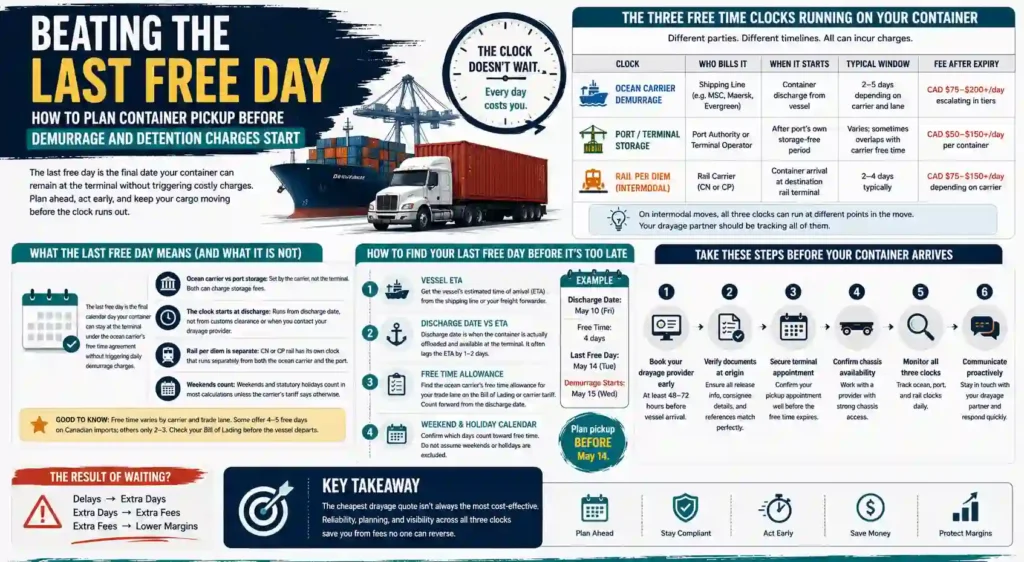
Six Steps to Plan Your Container Drayage Services Around the Last Free Day
This is the planning sequence that keeps containers out of demurrage on most routine GTA import lanes. Run through it before each vessel arrival.
Step 1: Read the Bill of Lading when it is issued
The Bill of Lading contains the ocean carrier’s free time terms and the container identification number. Read it when it is issued, not when the vessel arrives. Note the free time window, the discharge port, and the intermodal terminal if one is specified.
Step 2: File your customs entry as soon as the commercial invoice is available
A customs hold after discharge is the most common reason containers miss the last free day. File your entry with the Canada Border Services Agency as soon as your supplier sends the commercial invoice and packing list, ideally before the vessel departs the origin port. If customs clears before discharge, your container drayage services provider can book the terminal appointment immediately on availability.
Step 3: Contact your container drayage services provider at least 48 to 72 hours before the last free day
Do not wait for the container to be discharged. Share the last free day, the terminal, the container number, and the customs clearance status at booking. The best container drayage services teams book the terminal appointment from the vessel manifest before discharge, so they already have a window by the time the container is available.
Step 4: Confirm the terminal appointment and chassis availability
Ask the carrier to confirm the appointment time and chassis source before pickup day. GTA chassis pool shortages during peak import season (October-December) are a real scheduling constraint. A confirmed chassis and appointment window gives you a concrete pickup date to plan your receiving dock around.
Step 5: Confirm your dock appointment before the drayage truck arrives
Detention charges accumulate when the truck waits at your facility without a dock window. Have a receiving appointment in your facility management system before the container drayage services team dispatches the driver. Share the scheduled delivery window with your carrier so they can time the pickup from the terminal accordingly.
Step 6: Note the container return deadline and plan the unload accordingly
Once the container is delivered, the ocean carrier’s detention clock starts. Confirm the return deadline with your carrier at delivery and build your unload timeline around it. Ask the container drayage services provider when they will return the empty to the terminal, and confirm that timing before the truck leaves your dock.
Good to know: On high-volume import seasons (October through December) GTA terminal appointment windows can fill two to three days out. A container drayage services provider who books from the manifest rather than waiting for discharge availability has a significant advantage in securing the earliest possible appointment.
What Happens When the Last Free Day Passes Without Pickup
Missing the last free day on a GTA import container is not catastrophic on the first day. It becomes costly when it extends. Here is how charges typically accumulate on a container held at a GTA terminal past free time.
| Days Past Last Free Day |
Approximate Daily Demurrage (ocean carrier) |
Port Storage (terminal) |
Combined Approximate Daily Exposure |
| Day 1-2 |
CAD $75-$150/day |
CAD $50-$100/day |
CAD $125-$250/day |
| Day 3-5 |
CAD $150-$250/day (escalated tier) |
CAD $50-$100/day |
CAD $200-$350/day |
| Day 6+ |
CAD $250-$400+/day (further escalation) |
CAD $50-$150/day |
CAD $300-$550+/day |
These are approximate ranges for illustrative purposes. Actual rates are on the ocean carrier’s tariff and the terminal’s published schedule. The point is that combined charges for a container held five to seven days past the last free day in the GTA can easily reach $1,500 to $2,500 or more, depending on the carrier and the terminal. Confirm the actual rates on your next BOL.
How S&R Trucking Manages Container Drayage Services for Time-Critical Moves
S&R Trucking provides
container drayage services in Ontario from its base in Kleinburg, with in-house dispatch and consistent access to GTA intermodal terminals on the CN and CP network. S&R has been part of an intermodal network since 1992 and handles the full coordination from terminal appointment to delivery for importers managing regular GTA container volumes.
When you book container drayage services with S&R, share the last free day and the customs status at booking. We will track the container status, book the terminal appointment as early as the vessel manifest allows, and notify you before any condition changes. We handle both the pickup leg and the container return so the detention clock is managed on both sides of the move.
Ready to get ahead of your next last free day? Call S&R Trucking at 905-951-2951 or
request a container drayage services quote through the contact page. For a deeper look at the causes of drayage delays and how demurrage accumulates in practice, see our breakdown of
container drayage delays and demurrage fees.
Key Takeaways
- The last free day is the final calendar date a container can sit at the terminal before demurrage charges begin. It runs from the discharge date, not from customs clearance or when you contact your container drayage services provider.
- Three separate free time clocks can run simultaneously on an intermodal container: the ocean carrier’s demurrage window, the port’s own storage clock, and the rail carrier’s per diem. Each is billed separately.
- Weekends and statutory holidays count toward free time in most ocean carrier tariffs. A last free day that falls on a Saturday when the terminal is closed effectively shortens your usable window by one day.
- File customs as soon as the commercial invoice is available. A customs hold after discharge is the most common reason containers miss the last free day on GTA import lanes.
- Contact your container drayage services provider at least 48 to 72 hours before the last free day, not after discharge. Share the container number, terminal, last free day, and customs status at booking.
- Confirm a terminal appointment and chassis availability before the pickup day. GTA pool chassis shortages during October-December are a predictable constraint.
- Have a receiving dock appointment ready before the container drayage services driver arrives. Detention charges accumulate when the truck waits without a dock window.
- Combined demurrage and port storage charges on a container held five to seven days past the last free day in the GTA can reach $1,500 to $2,500 or more. The planning process above prevents most of that exposure.
Frequently Asked Questions
What are container drayage services?
Container drayage services are the truck-based movement of shipping containers between intermodal terminals, such as port facilities and rail ramps, and the importer’s facility or the next transport leg. In Canada, container drayage services cover the pickup from GTA intermodal terminals and delivery to warehouses and distribution centres across Ontario. A container drayage services provider coordinates the terminal appointment, dispatches the truck, and manages the move from the terminal gate to delivery.
What is the last free day on a container shipment?
The last free day is the final date the ocean carrier allows a container to remain at the terminal before charging demurrage. It is calculated from the container’s discharge date, not the vessel’s arrival date or the customs clearance date. Free time periods vary by ocean carrier and trade lane, typically ranging from two to five days on Canadian import lanes. The free time window is specified in the carrier’s tariff and on the Bill of Lading.
How do I plan my container drayage services around the last free day?
Read the Bill of Lading when it is issued to confirm the free time window. File your customs entry as early as possible so clearance is in hand before discharge. Contact your container drayage services provider at least 48 to 72 hours before the last free day, sharing the terminal, container number, and customs status. Confirm a terminal appointment and chassis availability at booking, and have a dock appointment ready before the driver arrives for delivery.
Are ocean carrier free time and port storage free time the same thing?
No. Ocean carrier free time (demurrage) and port storage free time are separate windows billed by different parties. The ocean carrier charges demurrage for containers not removed from the terminal within the carrier’s free time. The port or terminal operator charges storage independently. Both can run simultaneously, and both can start accumulating charges at the same time if the container is not picked up. Confirm both windows with your freight forwarder or on the shipping line’s terminal information.
How far in advance should I book container drayage services?
Book container drayage services at least 48 to 72 hours before the last free day. For GTA terminal lanes during the October-December peak import season, booking even earlier is advisable because appointment windows fill faster. The best container drayage services providers book from the vessel manifest before discharge, giving them an appointment window ready the moment the container is available. Ask your carrier when they typically schedule the appointment relative to the estimated discharge date.
What happens if my container misses the last free day?
Demurrage charges begin the day after the last free day and typically escalate in tiers over the following days. Port storage charges may also accumulate separately. Combined demurrage and storage charges on a GTA container held five to seven days past the last free day can reach $1,500 to $2,500 or more depending on the carrier and terminal. On intermodal moves, rail per diem charges from CN or CP may also apply if the container was at a rail terminal. The practical response is to contact your container drayage services provider immediately, confirm the customs clearance status, and book the earliest available terminal appointment to stop the clock.
S&R Trucking TeamSince 1992, S&R Trucking has been one of Ontario's leading intermodal carriers, combining FTL, LTL, drayage, flatbed and secure storage with 24/7 dispatch across Canada and North America.
Ready to Move Your Freight?
Talk to a real dispatcher today and get a free, no-obligation quote for your next shipment.
REQUEST A FREE QUOTES&R Trucking TeamSince 1992, S&R Trucking has been one of Ontario's leading intermodal carriers, combining FTL, LTL, drayage, flatbed and secure storage with 24/7 dispatch across Canada and North America.
Ready to Move Your Freight?
Talk to a real dispatcher today and get a free, no-obligation quote for your next shipment.
REQUEST A FREE QUOTE
 August 20, 2026 - By : S&R Trucking Team

1 Comment
Container Terminal Pickup Documents Ontario: Drayage Checklist
[…] If your container is approaching its last free day and customs is still pending, read our guide to container drayage last-free-day planning. […]