 November 9, 2026 - By : S&R Trucking Team
Full truckload shipping starts to make sense the moment a shared-freight quote for a dozen pallets lands close to the price of a dedicated trailer, and most shippers only notice after paying the gap for a few months. If freight leaves your dock in the GTA every week, a little arithmetic now saves a lot of invoice frustration later.
Full truckload shipping pays off when your freight fills most of a trailer by space or weight, when it is fragile or time-sensitive, or when terminal handling is costing you more in claims and delays than you save per pallet. For many Ontario shippers the break-even point sits well below a full trailer, so compare real quotes at several pallet counts before defaulting to shared freight.
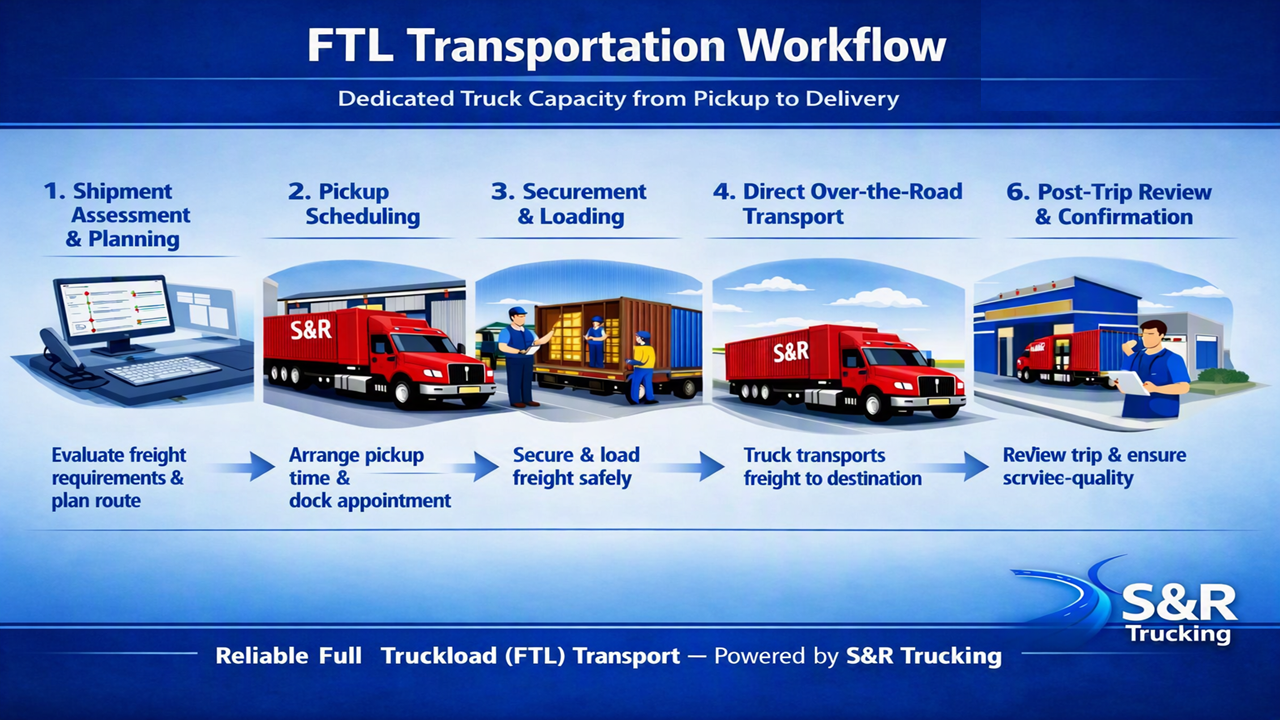
Full truckload shipping means one shipper’s freight gets one trailer for the whole move. The driver loads at your dock, seals the trailer, and drives to your receiver without stopping at a terminal to consolidate or transfer anything. That single fact explains most of the benefits: fewer touches, tighter transit times, and a clear line of responsibility if something goes wrong.
It does not mean the trailer has to be physically full. You pay for the use of the trailer, and the rate reflects the lane, the distance and the equipment, not the pallet count. A load of 14 pallets and a load of 26 pallets can price very closely on the same lane, which is exactly why the break-even question matters.
S&R Trucking runs full truckload services across Ontario, nationwide and cross-border into the USA, using dry vans and power tailgate equipment matched to the job. Still deciding whether you need a whole truck? Our earlier piece on whether you actually need a whole truck is a good place to start.
Before you compare rates, know what a trailer can hold. A standard 53-foot dry van commonly fits about 26 standard 48 by 40 inch pallets loaded in a single layer on the floor, and more when the pallets can be turned or stacked safely. Light, bulky freight such as packaging fills the space before it reaches the weight limit. Dense freight such as metal parts or bagged product reaches the weight limit first.
Weight limits in Ontario depend on axle configuration and permitted gross weight, so a heavy load that looks fine on paper can still need to be split or re-planned. The province explains how limits and permits work in its guide to oversize and overweight vehicles and loads. Your carrier checks this before dispatch, but the most useful numbers you can bring to a quote request are these:
The break-even point is the pallet count where the LTL price for your whole shipment equals the flat price of full truckload shipping on the same lane. Shared freight is priced per shipment by weight, freight class and distance, so the cost climbs with every pallet you add. A truckload rate barely moves. Our overview of LTL services explains when shared trailer space is the cheaper choice, and it usually is for a pallet or two.
Here is the part most quote comparisons miss: the crossover usually arrives before the trailer is full. Once you add accessorials such as liftgate service, limited-access delivery, and reweigh or reclassification fees, the gap closes faster than the base rate suggests.
| Factor | Full truckload | Shared (LTL) |
|---|---|---|
| Pricing basis | Flat rate per trailer, set by lane | Per shipment, by weight, class and distance |
| Handling | Loaded once, unloaded once | Handled at origin and destination terminals |
| Transit time | Direct, no consolidation stops | Depends on terminal schedules |
| Damage and claim exposure | Lower, fewer touches | Higher, more handling |
| Cost as you add pallets | Stays nearly flat | Rises with each pallet |
| Best fit | Large, fragile or time-sensitive freight | Small shipments of a few pallets |
A dedicated truck earns its keep where a rate comparison understates the real cost of shared freight.
Every terminal transfer is another chance for a forklift to find your pallet. Full truckload freight is secured once and stays put until it reaches your receiver, which is why damage claims tend to drop when shippers switch.
Retail and manufacturing receivers often hold firm appointment slots. Full truckload freight can be planned around that slot. A shared trailer cannot, because it depends on every stop ahead of yours.
If you move the same full truckload freight from the GTA to Montreal along the 401 corridor every week, a carrier can plan equipment and drivers around your schedule. That consistency is hard to buy on shared trailers.
Repeat the check whenever your volumes change, since seasonal peaks can push a lane across the line.
Geography changes the maths. Out of the GTA, a truck can be on the 400-series highways within minutes and onto the 401 corridor toward Quebec the same morning, which makes Ontario to Quebec runs natural candidates for our full truckload services.
Our full truckload services pair dedicated capacity with GPS-tracked equipment and direct dispatch support, so you can ask where your freight is and get a straight answer. When a storm closes a stretch of the 401, a dedicated driver can be rerouted or held with your freight in mind, while a terminal-based shipment waits for the next scheduled move.
Some freight sits awkwardly between a few pallets and a whole trailer. For that middle ground, our partial load solutions let you share trailer space without pushing your freight through a terminal network. If your quotes show full truckload shipping costing only slightly more than shared freight, take the truck. If the gap is large, a partial load is often the sensible compromise.
Need full truckload services out of the GTA? Call S&R Trucking at 905-951-2951 and we will compare truckload, partial and LTL pricing on your actual lane.
Full truckload shipping is a freight service where one shipper’s goods occupy an entire trailer from pickup to delivery. The freight is not mixed with other customers’ shipments and does not pass through a consolidation terminal. S&R Trucking provides full truckload services across Ontario and beyond.
A standard 53-foot dry van commonly fits about 26 pallets of 48 by 40 inches when loaded in a single layer. Stackable freight can raise that number, while heavy freight may reach the weight limit before the floor is full.
There is no single number, because it depends on your lane, freight class, weight and accessorial charges. Many shippers find the crossover well before 26 pallets, so request both quotes at your usual pallet count and compare.
Generally, yes. Fewer touches mean fewer chances for damage, and the load is secured once by a driver trained in securement. That is why fragile and high-value freight is a common reason to move to a dedicated truck.
Yes, the truckload rate reflects the trailer and the lane, not the number of pallets you load. If your freight fills only part of a trailer, ask about partial load options as well.
Have your pickup and delivery locations, pallet count, total weight and requested dates ready, then call S&R Trucking at 905-951-2951. We will quote the lane and compare it with your current shared-freight spend.
Talk to a real dispatcher today and get a free, no-obligation quote for your next shipment.
REQUEST A FREE QUOTETalk to a real dispatcher today and get a free, no-obligation quote for your next shipment.
REQUEST A FREE QUOTE
Leave a comment