If you’ve ever watched a shared-trailer shipment show up a day late with a corner crushed, you’ve probably wondered whether full truckload services are worth it for your freight. It’s a fair question, and the honest answer is “sometimes, and here’s how to tell.” A whole truck costs more up front than squeezing a few pallets onto someone else’s trailer, so you’ll want to know you’re getting something for it.
Full truckload services give your shipment its own trailer from one pickup to one delivery, with no other companies’ freight on board and no stops to drop or swap pallets. You choose full truckload when you can fill most of a 53-foot trailer, when the delivery can’t be late, or when the goods are fragile or valuable enough that you’d rather nobody handle them twice. That’s the whole idea in a few sentences. Now the details that actually help you decide.
Trucks do the heavy lifting in this country. About 72.6% of Canada’s land freight tonnage moves by road, according to Statistics Canada, so the way you book that trailer space has a real effect on both your costs and your delivery dates.
So what does “full truckload” really mean?
Picture your freight as the only thing on the truck. The driver loads it at your dock, closes the doors, and that same trailer rolls straight to where it’s going. Nothing gets unloaded at a terminal halfway, nothing gets restacked, nobody else’s skids are wedged in beside yours.
That “nothing in between” part is really the point. Every time freight is cross-docked, it gets picked up, moved, and set down again, and each of those moments is a chance for a wrong scan or a dropped pallet. Full truckload services skip all of it. Fewer hands on your freight simply means fewer things that can go sideways.
Which leads straight to the question most people ask next.
But do I have enough freight to fill a whole truck?
You might have less than you think, and that’s okay. A 53-foot trailer holds around 26 pallets, but you don’t have to fill the floor to book one.
Heavy or bulky freight often books a full truck long before it runs out of space. Plenty of shippers reserve a whole trailer at ten or twelve pallets just for the speed and gentler handling, not the rock-bottom rate. So the real question isn’t only “do I have 26 pallets,” it’s “is my freight heavy, urgent, or delicate enough that full truckload services make sense.”
Full truckload or LTL: which one do I actually need?
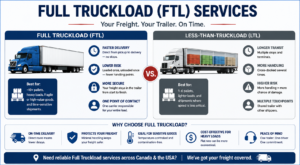
The right pick between full truckload services and
LTL depends on how much you’re moving, how fast it needs to arrive, and how well it survives handling.
| What you’re weighing |
Full Truckload (FTL) |
Less-Than-Truckload (LTL) |
| The trailer |
Yours alone |
Shared with other shippers |
| Typical size |
Around 10+ pallets, or heavy loads |
1 to 6 pallets |
| Speed |
Faster, straight there |
Slower, stops and terminals |
| Handling |
Loaded once, unloaded once |
Cross-docked several times |
| Damage risk |
Lower |
Higher |
| How it’s priced |
One flat rate for the truck |
By weight, space, and freight class |
If you ship small and often,
LTL services are usually the cheaper, sensible call. If you’re stuck in that awkward middle, too much for LTL but not quite a full load, that’s exactly what
partial load solutions exist for. Match the mode to the freight.
Worth knowing: because LTL is priced by weight, space, and freight class, a heavy or dense shipment can actually come back cheaper as a flat full truckload rate than as LTL. It’s a good reason to quote both ways.
Say the comparison points you toward full truckload services. The next thing on your mind is usually whether it’s genuinely worth the spend.
When is paying for a full truck actually worth it?
Full truckload services earn their keep when one or more of these is true for your shipment:
- You can fill, or nearly fill, a trailer, or the freight is heavy enough that a flat truck rate beats paying by weight.
- The delivery is on a clock and can’t absorb the extra days that terminal stops add.
- The goods are fragile, valuable, or awkward, and every extra touch is a risk you’d rather not take.
- It’s temperature- or contamination-sensitive and shouldn’t share a trailer with anything else.
- You want one carrier on the hook for the whole load, with no hand-offs to point fingers at when something slips.
If none of that fits and you’re sending two pallets across town, a whole truck is more than you need, and a good carrier will tell you so. And if speed is your main reason, that raises a fair question: how reliable is the timing really?
Can I actually count on the delivery date?
This is the part that keeps shippers up at night, and it’s one of the strongest reasons to book full truckload services. Because full truckload services run straight from your dock to the destination with no terminal stops, the transit time is predictable. The driver isn’t waiting for a trailer to fill or routing through a sort facility, so the quoted date is one you can build a schedule around.
On a regional lane like the GTA to Montreal, that often means next-day or two-day delivery you can plan an appointment window around. LTL can’t promise the same, because your pallets move on the network’s schedule, not yours, and one busy terminal can quietly add a day. If a customer charges back late deliveries, that certainty is worth more than the few dollars a shared trailer saves. With full truckload services, it’s the difference between hoping it shows up and knowing when it will.
What should I have ready before I book?
Once you’ve decided it’s worth it, getting a quote goes faster when you have a few details handy. Here’s what a carrier will ask before pricing your full truckload:
- Pickup and delivery addresses, with any dock hours or appointment details.
- What you’re shipping: the commodity, the weight, and the number of pallets or pieces.
- Dimensions, especially if anything is oversized or stacked tall.
- Whether either end needs a tailgate, inside delivery, or a forklift on site.
- Your ready time and any hard delivery deadline.
None of this is complicated, but having it ready means the quote comes back accurate the first time. Shop it around and you’ll notice the numbers don’t always line up.
So why do two full truckload quotes come back so different?
You ask three carriers for the same lane and get three different numbers. What gives?
A full truckload rate looks like one tidy figure, but it’s built from real parts: the lane itself (distance and direction), fuel, the driver’s time, any wait time at busy docks, and extras like a tailgate or an inside delivery.
The piece most people never see is the empty-mile problem. If a truck drops your load and has nothing to haul back, somebody pays for that return trip, and it’s baked into your rate. A carrier that already has freight coming back from your destination can quietly price the lane tighter than one that runs your load out and comes home empty. So a cheaper quote often isn’t a corner being cut, it’s better return-freight planning. That’s also a clue about who you actually want moving your freight.
How does S&R handle a full truckload?
S&R Trucking runs
full truckload (FTL) services out of Kleinburg, Ontario, right on Highway 50. As a GTA trucking company, it handles full truckload shipping in Ontario, the Ontario to Quebec lanes, and points across Canada, plus cross-border runs into the US. Roughly two-thirds of Canada to US trade crosses the border by truck, according to Transport Canada, so that capacity matters if you ship south. A cross-border freight carrier from Canada to the US also has to meet FMCSA safety and hours-of-service rules, which S&R manages for you. As part of an
intermodal network since 1992, S&R also handles
container and
drayage moves by rail and truck together when that works better on a longer haul.
Because S&R runs full truckload,
LTL,
partial,
flatbed, and container service all under one roof, the advice stays honest about which one fits. If full truckload services are the right call, that’s what you’re quoted. If your freight would ride cheaper as a partial load, you’ll hear that too. One carrier owns the shipment start to finish, so when you phone for a status, you’re talking to the people actually moving it.
If you need full truckload services out of the GTA or a lane into Quebec or the US, call S&R Trucking at
905-951-2951 or
request a quote. You’ll get a straight answer on mode, timing, and price.
Frequently Asked Questions
What does full truckload mean?
Full truckload, or FTL, means your shipment books an entire trailer for itself and travels directly from pickup to delivery with no other shippers’ freight on board. It’s the opposite of less-than-truckload, where several companies share one trailer. Full truckload is the usual choice for larger, heavier, time-sensitive, or fragile loads.
How many pallets is a full truckload?
A standard 53-foot dry van holds roughly 26 standard pallets, but you don’t always need a full floor to book one. Many shippers use full truckload services at around 10 or more pallets, or sooner when the freight is heavy, bulky, or sensitive enough that a flat truck rate and fewer touches make more sense than LTL.
Is full truckload cheaper than LTL?
Sometimes, yes. LTL is priced on weight, space, and freight class, so a heavy or dense shipment can cost less as a flat full truckload rate than as LTL. For a few light pallets, LTL is usually cheaper. The only sure way to know is to quote the same shipment both ways, which a carrier that runs both modes can do for you.
How much do full truckload services cost in Ontario?
There’s no single number, because the rate depends on the lane, distance, fuel, wait time, and any extras like a tailgate or inside delivery. A GTA to Montreal run prices very differently from a long haul across Canada, and return freight matters too. The best move is to get a quote for your specific lane rather than trust a generic figure.
When should I use full truckload shipping instead of LTL?
Use full truckload services when you can fill or nearly fill a trailer, when the delivery is time-sensitive, or when the goods are fragile, valuable, or shouldn’t share a trailer. If you’re moving only a pallet or two with no rush,
LTL or a
partial load is usually the better value.
About S&R Trucking
This guide was written and reviewed by the team at S&R Trucking Inc, an Ontario freight carrier based at 10481 Highway 50 in Kleinburg, ON and part of an intermodal network since 1992. S&R moves full truckload, LTL, partial, flatbed, drayage, and container freight across Canada and into the US, so the guidance here comes from people who book these loads every day. Have a shipment to price? Call
905-951-2951 or
request a quote.
S&R Trucking TeamSince 1992, S&R Trucking has been one of Ontario's leading intermodal carriers, combining FTL, LTL, drayage, flatbed and secure storage with 24/7 dispatch across Canada and North America.
Ready to Move Your Freight?
Talk to a real dispatcher today and get a free, no-obligation quote for your next shipment.
REQUEST A FREE QUOTES&R Trucking TeamSince 1992, S&R Trucking has been one of Ontario's leading intermodal carriers, combining FTL, LTL, drayage, flatbed and secure storage with 24/7 dispatch across Canada and North America.
Ready to Move Your Freight?
Talk to a real dispatcher today and get a free, no-obligation quote for your next shipment.
REQUEST A FREE QUOTE
 August 6, 2026 - By : S&R Trucking Team

1 Comment
Flatbed Trucking in Ontario and Canada’s Build Push
[…] and packaged goods lean dry van. If you are not sure what counts as a full truckload, our guide to full truckload services walks through it. Many project shippers need both: open decks for steel and lumber, and full […]