If your freight regularly travels a long way across the country, intermodal rail deserves a spot in the conversation. Intermodal shipping combines two modes rail for the long middle stretch and trucks for the short legs at each end to move your container cheaper and cleaner than trucking the whole way. For the right freight and the right lane, it can cut both your cost and your emissions with little trade-off. For the wrong one, it adds days you can’t spare.
Here’s how intermodal works, when it beats straight trucking, and when it doesn’t.
What Is Intermodal Shipping, and How Does It Actually Work?
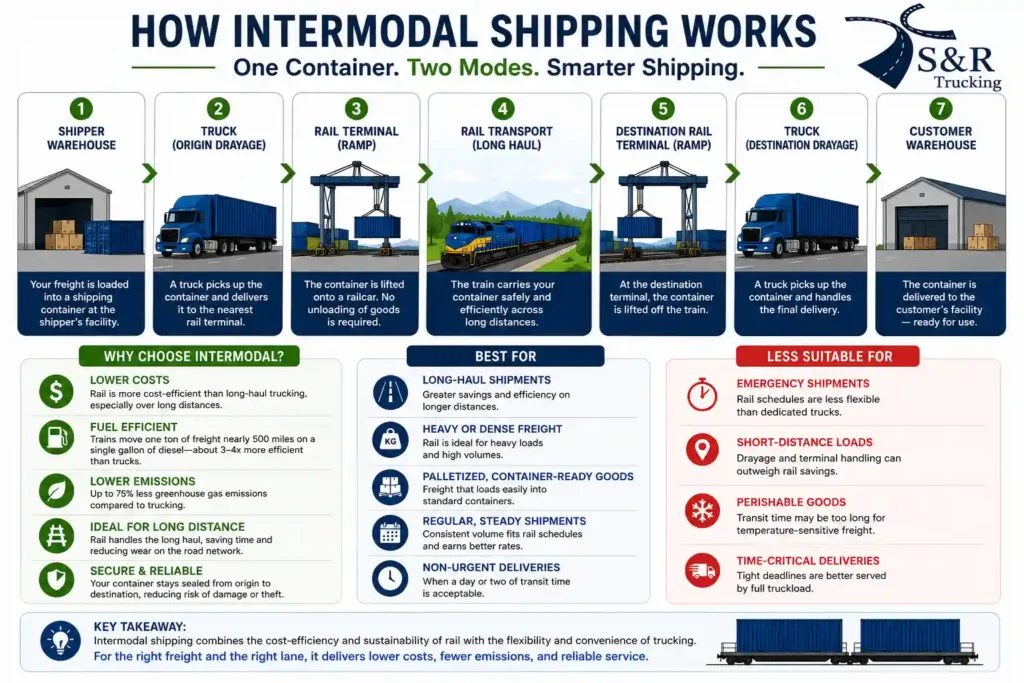
Intermodal shipping means moving one container across more than one mode of transport without repacking the freight inside. The container is the constant. It gets loaded once, then travels by whatever combination of truck and rail makes sense.
A typical intermodal rail move looks like this: a truck picks up your loaded container and drays it to a rail terminal, the “ramp.” The container is lifted onto a railcar, often double-stacked with another, and the train hauls it the long distance. At the destination ramp, another truck collects it and delivers it to the door. That short truck leg at each end is drayage, and it’s what ties the rail network to your dock.
Intermodal rail shipping moves your freight in a single container that travels by rail for the long middle stretch and by truck for the short legs at each end, and loses on short hauls or tight, time-sensitive deliveries.
Why Combine Rail and Truck Instead of Just Trucking the Whole Way?
Because trains are remarkably efficient at moving heavy freight over distance, and trucks are unbeatable for the flexible last leg. Put them together and you get most of the savings of rail with most of the convenience of trucking.
That efficiency shows up in your rate on long lanes, and in lower emissions, which matters more to shippers reporting on sustainability every year.
Good to know: a single intermodal train can carry the freight of several hundred trucks. On a long, high-volume lane, that scale is exactly why intermodal rail prices below over-the-road trucking.
When Does Intermodal Rail Beat Long-Haul Trucking?
Intermodal tends to win when several of these are true:
- The distance is long enough. The further the haul, the more the rail leg’s cost advantage compounds. Most intermodal lanes start around 500 miles or more.
- The volume is steady. Regular, repeatable shipments fit the rail schedule and lock in better rates.
- The freight isn’t in a hurry. If a day or two of extra transit is fine, intermodal’s slower schedule is a non-issue.
- Cost and emissions matter more than speed. For price-sensitive or sustainability-focused freight, intermodal is often the smarter mode.
- The goods are container-friendly. Palletized, non-perishable, non-urgent freight rides intermodal well.
If your lane checks most of those boxes,
container transportation by intermodal rail is worth pricing against a straight truck move.
When Is Intermodal Not the Right Call?
Just as important is knowing when to skip it. Intermodal usually loses on short hauls, because the two
drayage legs and the ramp handling eat up the rail savings before the train even helps. It also struggles with tight, time-sensitive deliveries, since rail schedules are less flexible than a dedicated truck and a missed connection can cost you a full day.
If your freight needs white-glove handling, temperature control, or a guaranteed delivery window measured in hours, a straight truck is almost always the better choice. The same applies when you’re shipping to or from a location far from a rail terminal long drayage legs can wipe out the savings entirely.
Be cautious of brokers or carriers pushing you toward the mode they happen to sell. A good freight partner runs both intermodal and over-the-road service, so they’re not pushing you toward the mode they happen to sell.
What Kinds of Freight Are a Good Fit for Intermodal?
Not every shipment belongs on a train, but a lot more do than most shippers assume. Intermodal rail suits freight that is:
- Palletized and container-ready, so it loads and rides cleanly.
- Non-perishable, since the schedule is steadier but slower than a dedicated truck.
- Medium to heavy weight, where rail’s ton-mile efficiency matters most.
- Not time-critical, so a day or two of buffer is acceptable.
Common examples include auto parts, building materials, consumer goods, dry food products, and industrial supplies. If you’re shipping full containers of palletized product on a repeating lane, intermodal is almost certainly worth quoting.
Why Drayage Quality Matters as Much as the Rail Rate
Weak drayage undoes the benefit of a good rail rate. If the container sits at the ramp waiting for a truck, you burn time and risk fees. That’s why the strongest intermodal service comes from a carrier who handles the drayage themselves, so the rail and truck legs are coordinated rather than handed off between companies pointing fingers.
How Much Can Intermodal Save, and What’s the Trade-Off?
The savings come from that fuel and scale advantage on the rail leg, and they grow with distance. On a long lane with steady volume, intermodal rail frequently prices below trucking, sometimes meaningfully. As a rough rule, the longer the lane, the wider the gap: on a cross-country haul, intermodal rail can undercut a truck rate while cutting emissions per ton-mile by more than half, whereas on a 300-kilometre regional run the gap often disappears because the two drayage legs eat the savings before the train helps.
The trade-off is transit time and flexibility. Intermodal typically takes a bit longer than a team-driven truck and runs on the railroad’s schedule, not yours. There’s also a small amount of extra handling at the ramps. For most non-urgent freight, those trade-offs are easily worth the savings and the lower emissions. For a hot load due tomorrow, they’re not and any honest carrier will tell you that rather than making you wait for someone else’s truck.
Running both intermodal and over-the-road service also means honest advice. If your lane and timeline suit intermodal rail, S&R will price it that way. If a straight truck is faster and cheaper for your shipment, you’ll hear that instead. Trucks still move about 72.6% of Canada’s land freight, according to Statistics Canada, so the goal is to use rail where it wins and trucking where it wins. Cross-border containers also have to meet FMCSA rules in the US, which S&R handles as part of the move.
If you ship long-haul freight in or out of Ontario, call S&R Trucking at 905-951-2951 or request a quote to see whether intermodal beats trucking on your lane.
Frequently Asked Questions
What is intermodal rail shipping?
Intermodal rail shipping moves a single container across more than one mode, typically a truck to the rail ramp, a train for the long haul, and a truck at the other end, without unloading the freight inside. It combines rail’s efficiency over distance with a truck’s flexibility on the short legs. The container stays sealed the whole way.
Is intermodal cheaper than trucking?
On long lanes with steady volume, usually yes. The rail leg’s fuel and scale advantage grows with distance, so cross-country intermodal often undercuts over-the-road trucking meaningfully. On shorter runs or one-off shipments, the two drayage legs and ramp handling can eat the savings, making a straight truck the better deal.
How long does intermodal shipping take compared to trucking?
Intermodal typically adds a day or two compared to a direct truck, mainly because of ramp scheduling and the train’s fixed departure times. For most non-urgent freight that buffer is a fair trade for lower cost and lower emissions. For time-critical shipments, a dedicated truck is faster and more flexible.
What is drayage in intermodal shipping?
Drayage is the short truck move at each end of an intermodal trip — picking up the container from the shipper and delivering it to the rail ramp, then collecting it at the destination ramp and delivering it to the final door. Good drayage keeps the container moving on schedule; poor drayage adds delays and fees that can wipe out the rail savings.
Is intermodal shipping better for the environment?
Generally, yes. Trains move a ton of freight significantly farther per litre of fuel than trucks, so shifting long-haul volume to rail cuts carbon emissions per shipment. For companies tracking sustainability, shifting long-haul volume to intermodal is one of the simplest ways to cut freight emissions.
This guide was written and reviewed by the team at
S&R Trucking Inc, an Ontario freight carrier based at 10481 Highway 50 in Kleinburg, ON and part of an
intermodal network since 1992. S&R moves freight by intermodal rail, container transportation, and
drayage, along with
LTL, partial,
flatbed, and
full truckload service across Ontario and into the US, so the guidance here comes from people who coordinate rail and truck legs every day. Have a long-haul lane to price? Call 905-951-2951 or
request a quote.
Sources: Association of American Railroads: Freight Rail Facts and Figures; Statistics Canada: Transportation data; Ontario Trucking Association.S&R Trucking TeamSince 1992, S&R Trucking has been one of Ontario's leading intermodal carriers, combining FTL, LTL, drayage, flatbed and secure storage with 24/7 dispatch across Canada and North America.
Ready to Move Your Freight?
Talk to a real dispatcher today and get a free, no-obligation quote for your next shipment.
REQUEST A FREE QUOTES&R Trucking TeamSince 1992, S&R Trucking has been one of Ontario's leading intermodal carriers, combining FTL, LTL, drayage, flatbed and secure storage with 24/7 dispatch across Canada and North America.
Ready to Move Your Freight?
Talk to a real dispatcher today and get a free, no-obligation quote for your next shipment.
REQUEST A FREE QUOTE
 July 21, 2026 - By : S&R Trucking Team

Leave a comment