An insulated shipping container is often the missing middle between a plain steel box in your yard and a powered reefer, and Ontario’s winters and summers make that middle ground worth understanding. If your inventory spoils, cracks or loses its shelf life when the temperature swings, the wrong storage choice shows up on your next stock count.
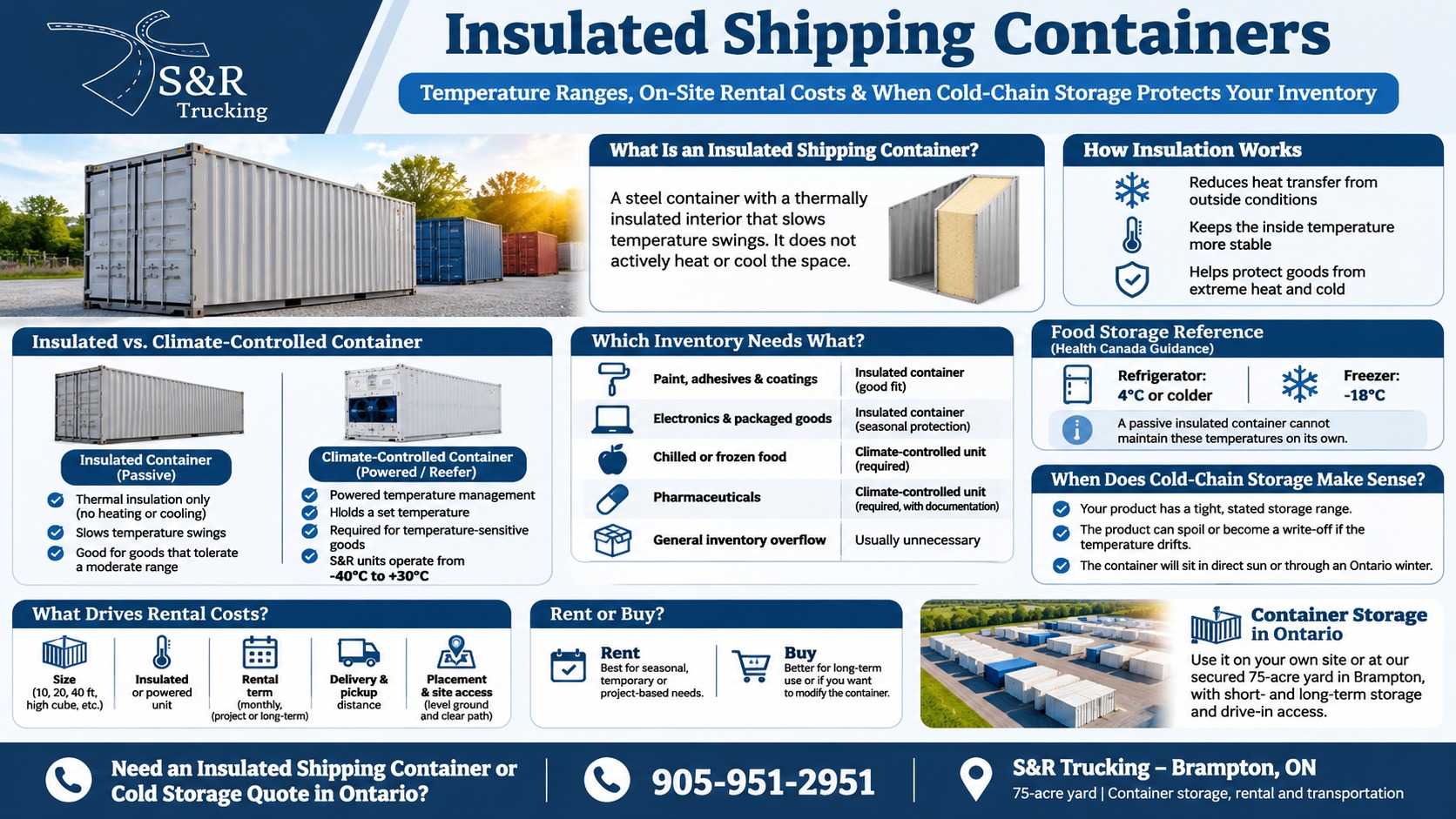
An insulated shipping container is a steel container lined with thermal insulation that slows temperature swings without actively heating or cooling the space. It suits goods that need protection from heat and cold extremes, while products that must stay within a fixed range, such as chilled food, need a powered climate controlled unit instead.
What Is an Insulated Shipping Container, Exactly?
An insulated shipping container starts life as a standard steel container, then gets a lined interior that reduces how quickly outside heat or cold moves inside. The insulation is passive. It does not generate cold, and it does not generate heat. It simply slows the exchange, so the inside temperature moves more gently than the weather outside.
That makes it different from a refrigerated unit, usually called a reefer, which has a powered system holding a set temperature. At S&R Trucking, our
container solutions include both options, alongside 10, 20 and 40 foot dry containers, high cube units and open-top containers. Knowing which one your inventory needs is the first decision, and it drives the cost.
Temperature Ranges: What Insulation Can and Cannot Do
Passive insulation is useful for goods that tolerate a moderate range but not extremes. Think paint and coatings, adhesives, electronics, packaged goods and seasonal inventory that suffers when a July heat wave bakes a steel box or a January cold snap drops well below freezing. The insulation takes the edge off. It does not promise a specific number on the thermostat.
Food and other products with strict limits are a different story. Health Canada’s
safe food storage guidance points to a refrigerator temperature of 4°C or colder and a freezer at -18°C, and a passive insulated shipping container cannot hold either on its own. Those goods need powered cooling. Our climate controlled units run from -40°C to +30°C and can be plugged in at our Brampton yard for on-site cold storage.
| Your freight |
Insulated container |
Powered climate controlled unit |
| Paint, adhesives, coatings |
Good fit, softens temperature swings |
Only if a strict range is required |
| Electronics and packaged goods |
Good fit for seasonal protection |
Useful for sensitive components |
| Chilled or frozen food |
Not enough on its own |
Required |
| Pharmaceuticals |
Not enough on its own |
Required, with documented temperatures |
| General inventory overflow |
Usually unnecessary |
Usually unnecessary |
If you are unsure which row describes your product, check the label or supplier data sheet first. The storage requirement printed there beats any rule of thumb.
What Drives On-Site Shipping Container Rental Costs?
Shipping container rental pricing is not a single number, so be wary of any quote that skips the details. We do not post flat rates because the right figure depends on your site and your product. These factors move the price of any container rental quote:
- Size. Larger units generally cost more to rent, and 20 foot is the most popular size for business storage.
- Insulated or powered. A powered unit needs an electrical connection, which adds a second line to the budget.
- Rental term. Short monthly or project terms keep upfront spend low, while buying outright can beat renting on very long timelines.
- Delivery and pickup. Distance from our yard, site access and whether the container needs to be set on level ground all matter.
- Placement and access. A flat, firm surface and clear delivery path keep the move simple and avoid extra visits.
Because we also operate the trucks, delivery and pickup are part of the same conversation rather than a separate invoice from a third party. For current rental rates and availability, call us at 905-951-2951.
Rent or Buy: How Long Do You Need It?
Plenty of Ontario businesses rent shipping containers for temporary, seasonal or project-based needs. You pay a monthly or project rate, the unit stays maintained by us, and you hand it back when the job ends. Buying suits permanent use, since you own the asset and can modify, paint or install it as you like.
A practical rule is to look at the calendar. If you will need the space for a season or a single project, rent. If you will still need container storage in several years, price a purchase as well. Either way, an insulated shipping container only earns its premium if your goods actually need the protection.
When Does Cold-Chain Storage Protect Your Inventory?
Cold-chain storage is worth the cost when a temperature failure costs more than the storage itself. Ask three questions about your inventory:
- What is the manufacturer’s stated storage range, and how tight is it?
- What happens to the product if it sits outside that range for a few days?
- Is the container going to sit in direct sun, on open ground, through an Ontario January?
If the answer to the first is a tight range, you need powered cooling. If the answer to the second is spoilage or write-off, treat storage as insurance. If the answer to the third is yes, even a modest insulated shipping container is better than a bare steel box.
Where the Container Sits Matters as Much as the Container
Container storage at a secured yard behaves differently from one dropped at the edge of a construction site. Our 75 acre Brampton yard offers short-term and long-term container storage with drive-in access for loading, ground-level placement for forklifts, and the same property as our trucks, which means fewer handoffs when you are ready to move freight. If you want to compare storage options first, our guide on
container storage solutions covers security and access in more detail.
Moving the container is the other half of the plan. Our
container transportation team delivers units to your site, repositions empties between the yard and the terminal, and uses flatbed or drop-deck equipment where a site has no dock. Placement, power and delivery are decided together, which keeps surprises off your invoice.
Need an insulated shipping container or cold storage quote in Ontario? Call S&R Trucking at 905-951-2951 and tell us what you are storing.
Key Takeaways
- An insulated shipping container slows temperature swings with passive insulation, but it does not heat or cool the space.
- Goods with a strict range, such as chilled food and pharmaceuticals, need a powered climate controlled unit.
- Our climate controlled units cover -40°C to +30°C and can be plugged in at the Brampton yard.
- Rental cost depends on size, insulated or powered, term, delivery distance and site access.
- Shipping container rental suits seasonal or project needs; price a purchase if you need container storage for years.
- Check the supplier’s stated storage range before choosing any container.
- Placement on firm, level ground and a clear delivery path avoid extra visits and fees.
- For an insulated shipping container quote, call S&R Trucking at 905-951-2951.
Frequently Asked Questions
What is an insulated shipping container?
An insulated shipping container is a steel container with a thermally insulated interior that slows how fast outside temperatures reach your goods. It has no active heating or cooling, so it moderates swings rather than holding a fixed temperature.
What is the difference between an insulated container and a climate controlled container?
Insulated units rely on passive insulation alone. A climate controlled shipping container, often a reefer, has a powered system that holds a set temperature. At S&R Trucking our climate controlled units run from -40°C to +30°C.
Can I store food in an insulated shipping container?
Not on its own if the food must stay refrigerated or frozen. Health Canada recommends a refrigerator at 4°C or colder and a freezer at -18°C, which requires a powered unit rather than passive insulation.
How much does it cost to rent an insulated shipping container?
The price depends on container size, whether it is insulated or powered, the rental term, delivery distance and site access. Call S&R Trucking at 905-951-2951 for current shipping container rental rates and availability.
Should I rent or buy a container for on-site storage?
Rent if you need the space for a season or a single project, since the rental is maintained for you and can be returned. Buy if you need it for several years or want to modify it.
Where can I find container storage in Ontario?
You can keep it on your own site or store it at our secured 75 acre yard in Brampton, which offers short-term and long-term storage with drive-in access.
S&R Trucking TeamSince 1992, S&R Trucking has been one of Ontario's leading intermodal carriers, combining FTL, LTL, drayage, flatbed and secure storage with 24/7 dispatch across Canada and North America.
Ready to Move Your Freight?
Talk to a real dispatcher today and get a free, no-obligation quote for your next shipment.
REQUEST A FREE QUOTES&R Trucking TeamSince 1992, S&R Trucking has been one of Ontario's leading intermodal carriers, combining FTL, LTL, drayage, flatbed and secure storage with 24/7 dispatch across Canada and North America.
Ready to Move Your Freight?
Talk to a real dispatcher today and get a free, no-obligation quote for your next shipment.
REQUEST A FREE QUOTE
 November 12, 2026 - By : S&R Trucking Team

Leave a comment