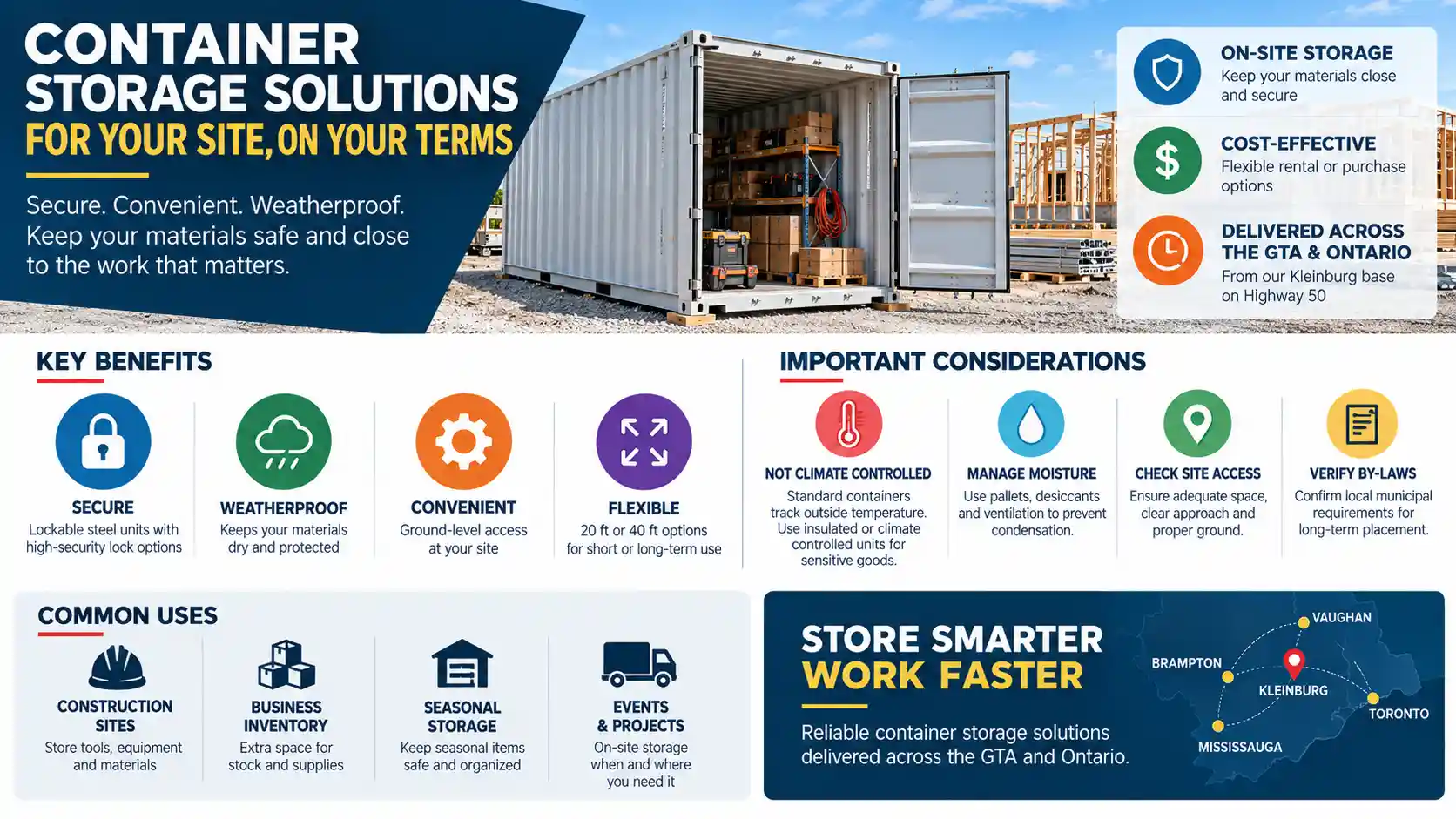
A site with nowhere to lock things up loses money in small pieces: a skid of fittings that walks off on a Friday, drywall that sat out through a wet weekend, tools nobody can find. Container storage solutions fix that by putting a lockable steel unit where the work happens, so your material stays dry, stays yours, and stays within reach.
Container storage solutions use standard shipping containers as secure, weatherproof storage placed at your own site rather than at a facility across town. A 20 ft or 40 ft steel container sits on your yard, job site, or lot, locks with a hardened padlock inside a lockbox, and gives you ground-level access without a forklift. S&R Trucking delivers and repositions container storage across the GTA and Ontario from our Kleinburg base on Highway 50.
What Container Storage Solutions Are, and What They Are Not
Container storage solutions start with a corrosion-resistant steel box built to sit on a ship’s deck in salt spray for weeks. That construction is why it works as storage: corrugated steel walls, doors sealing against a rubber gasket, and a frame that carries load at the corner castings.
What it is not is a climate-stable room. A standard container tracks outside temperature closely, swinging from below freezing to hot over an Ontario year, and does nothing on its own about humidity.
Good to know: a standard dry container is weatherproof, not airtight or insulated. If your goods are sensitive to temperature or moisture, you need an insulated shipping container or a climate controlled shipping container, not a standard unit.
Security: What Actually Keeps a Container Closed
Steel walls are rarely the weak point. Doors are. The security of container storage solutions comes down to four things, all worth checking before you load anything valuable.
- A lockbox.A welded steel shroud covering the padlock shackle so bolt cutters cannot reach it. Without one, a padlock is decoration.
- A high-security puck lock.Round, shrouded, and far harder to attack than a standard shackle padlock.
- Door orientation.Face the doors toward a wall, a fence, or another container so there is no room to swing them fully open.
- Placement and sightlines.Put it where site lighting and cameras already reach, not in the dark corner behind the trailers.
For longer stays, a lock bar or secondary hasp adds a step an opportunist will not bother with. None of it is expensive, and it is the difference between secure container storage and a steel box with a padlock on it.
Moisture, Condensation, and “Container Rain”
Here is the failure that catches people out with container storage solutions. Warm, humid air gets sealed inside during loading. Overnight the steel cools, the moisture condenses on the ceiling, and drips back onto your goods. It looks like a roof leak. It is not.
Ontario is prone to this: humid summers, sharp shoulder seasons, deep winter cold. Fixes that work:
- Load on a dry, cool day where you can, and avoid sealing in damp material.
- Keep goods off the floor on pallets or dunnage so air moves underneath.
- Use desiccant bags or hanging moisture absorbers, and replace them on a schedule.
- Add passive vents, or open the doors periodically when weather allows.
- Cover pallets loosely rather than shrink-wrapping tight, so trapped moisture can escape.
For electronics, documents, or anything with a paper label, an insulated or climate controlled unit is the safer answer. Confirm availability before you commit, since insulated and refrigerated units are a different class of equipment from a standard dry box.
Placement and Access: Where the Container Can Actually Go
Container storage solutions only work where the truck can reach. A 40 ft container needs roughly 100 ft of clear, straight approach for a tilt-deck or roll-off delivery, plus overhead clearance free of wires and branches. Tight urban lots in Toronto and Etobicoke get caught most often.
The ground matters too. Gravel, compacted base, or asphalt is ideal. Soft soil or fresh grade lets a corner sink, and once a container racks out of square, the doors stop closing properly. Blocking under the corner castings keeps the unit level and off standing water.
Check municipal rules before delivery. Several GTA municipalities treat a long-term container as requiring a permit or temporary structure approval, and rules differ between Vaughan, Toronto, Brampton, and Mississauga.
If a container is going on site for more than a few weeks, confirm the local by-law first. A permit question found after delivery is an expensive repositioning.
Rent or Buy? Comparing Container Storage Solutions
| Factor |
Renting |
Buying |
| Upfront cost |
Low, monthly |
Full purchase price |
| Best duration |
Weeks to a year or two |
Multi-year, permanent need |
| Maintenance |
Handled by the provider |
Yours: rust, seals, door gear |
| Flexibility |
Return or swap sizes |
You own it, and you move it |
| Condition |
Inspected before delivery |
Grade varies, inspect carefully |
Most GTA businesses rent first. Shipping container rental keeps the cost operational rather than capital and removes the resale problem if the need ends. If you buy, inspect in daylight: check the roof for ponding and rust, feel along the door seals, and have someone close the doors from inside to look for pinholes of light.
On-Site Container Storage vs Warehouse Storage
They solve different problems. On-site container storage solutions win when your team touches the material daily and it lives where the work is: construction sites, landscaping yards, equipment depots, retail overflow behind the store.
Warehouse space wins when goods are palletized, picked in small quantities, or shipped to multiple customers. That is where our
storage and warehousing solutions beat a container on a lot, because you get racking, dock doors, and staff handling the freight.
Plenty of Ontario businesses run both. If you are moving an owned container between sites, that is a
container transportation job, and if your unit is coming off a terminal,
drayage gets it out before per diem starts.
How to Set Up Container Storage Solutions in Five Steps
- Size it.A 20 ft container holds roughly ten standard pallets on the floor; a 40 ft roughly doubles that. Count pallets, not guesses.
- Pick the type.Standard dry for tools, materials, and general stock. Insulated or climate controlled for temperature-sensitive goods.
- Prepare the spot.Level, firm ground, clear approach, overhead clearance, doors facing a wall or fence.
- Confirm permits.Check the municipal by-law for anything beyond a short stay.
- Book delivery and set an access plan.Confirm who holds the keys and keep an inventory list, so nobody opens the doors to find out what is inside.
Need container storage solutions delivered in the GTA or across Ontario? Call S&R Trucking at
905-951-2951 or
request a quote with your site address, duration, and what you are storing. Our
container solutions page covers sizes and rental options.
Key Takeaways
- Container storage solutions put secure, weatherproof steel storage at your own site, with ground-level access and no forklift needed.
- Security depends on a lockbox, a puck lock, door orientation, and lit, visible placement, not on the steel itself.
- A standard container is weatherproof but not insulated, so condensation is the most common cause of damaged goods.
- Pallets, dunnage, desiccant, and passive venting prevent most moisture problems in an Ontario climate.
- Choose an insulated or climate controlled shipping container for electronics, documents, or anything temperature-sensitive.
- Delivery needs level ground and a clear straight approach, around 100 ft for a 40 ft unit, with no overhead wires.
- Many GTA municipalities require a permit for a container left on site long-term, so check the by-law before delivery.
- Renting suits needs under a year or two; buying makes sense only for permanent, multi-year storage.
- On-site container storage solutions fit daily-access material; warehousing fits palletized stock shipping to multiple customers.
Frequently Asked Questions
How secure are container storage solutions?
A steel shipping container with a lockbox and a high-security puck lock is one of the more secure on-site options available, since the walls and doors are built for marine shipping. Most break-ins target the padlock, so the lockbox is the single most important upgrade on any container storage solutions setup. Face the doors toward a wall or fence and keep the unit inside your site’s lighting and camera coverage.
Will my goods get damp inside a storage container?
They can, from condensation rather than leaks. Warm humid air sealed inside condenses on the cold steel ceiling overnight and drips down. Keep goods on pallets, use desiccant, add passive vents, and avoid loading damp material. For sensitive goods, use an insulated or climate controlled shipping container.
What size shipping container should I rent?
A 20 ft unit suits small job sites, tool and equipment storage, and retail overflow. A 40 ft unit suits larger inventory, building materials, and seasonal stock. Count pallets and measure your longest item first, since length is usually the deciding factor.
Do I need a permit to keep a shipping container on my property in Ontario?
Often, yes, particularly for stays beyond a few weeks. Rules vary by municipality across the GTA, and some treat a container as a temporary structure requiring approval. Check with your local by-law department before delivery, not after.
What ground do I need for container delivery?
Level, firm ground such as gravel, compacted base, or asphalt, with a clear straight approach of roughly 100 ft for a 40 ft container and no overhead wires or branches. Blocking under the corner castings keeps the unit square and off standing water.
Can S&R Trucking move a container I already own?
Yes. Moving a loaded or empty container between sites is standard container transportation work, and we reposition units across the GTA and Ontario. Call 905-951-2951 with the pickup and drop addresses, the container size, and whether it is loaded.
S&R Trucking TeamSince 1992, S&R Trucking has been one of Ontario's leading intermodal carriers, combining FTL, LTL, drayage, flatbed and secure storage with 24/7 dispatch across Canada and North America.
Ready to Move Your Freight?
Talk to a real dispatcher today and get a free, no-obligation quote for your next shipment.
REQUEST A FREE QUOTES&R Trucking TeamSince 1992, S&R Trucking has been one of Ontario's leading intermodal carriers, combining FTL, LTL, drayage, flatbed and secure storage with 24/7 dispatch across Canada and North America.
Ready to Move Your Freight?
Talk to a real dispatcher today and get a free, no-obligation quote for your next shipment.
REQUEST A FREE QUOTE
 September 11, 2026 - By : S&R Trucking Team

Leave a comment