Container transport in Canada follows a specific sequence, and most delays and unexpected costs happen at the handoff points between legs when one carrier’s timeline does not line up with the next carrier’s readiness. Once you understand how freight moves from the ocean vessel to your warehouse door, you can anticipate problems before they become expensive ones.
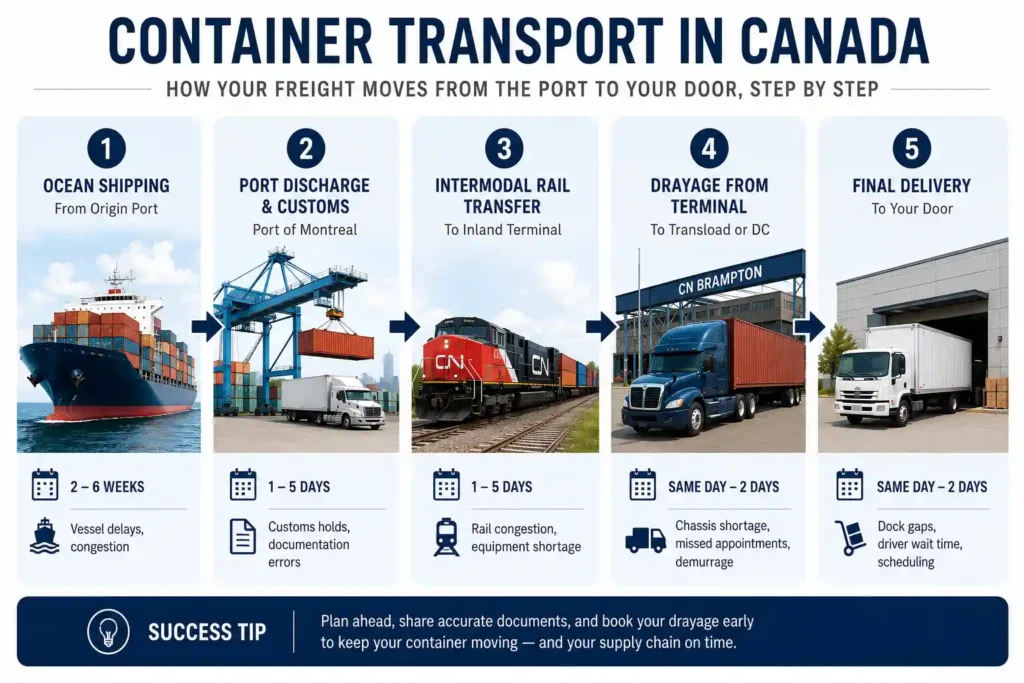
Container transport in Canada moves through five stages: ocean shipping from the origin port, discharge and customs clearance at a Canadian port such as the Port of Montreal, intermodal rail transfer to an inland terminal like CN Brampton or CP Vaughan, drayage from the terminal to a transload or distribution point, and final delivery by truck to your warehouse or dock. Each leg involves different carriers, different free time windows, and different fee structures.
What Container Transport in Canada Actually Involves
When Canadian importers talk about container transport, they typically mean the full journey of a loaded container from a foreign supplier to a domestic receiver. The ocean carrier handles the vessel portion. The port handles discharge. The intermodal rail network handles the inland long haul. The drayage carrier handles the terminal-to-door short haul.
Each of those legs is a separate commercial relationship with its own contracts, free time windows, and fee schedules. Total transit time from a foreign port of origin to your dock in the GTA can range from ten days to six weeks or more, depending on where your goods ship from, vessel schedule, customs clearance speed, and how quickly the drayage pickup is arranged.
The Five Stages at a Glance
The table below maps each container transport stage to who is responsible, a typical timeline, and the main risk at that stage.
| Stage |
Who Is Responsible |
Typical Timeline |
Main Risk |
| 1. Ocean shipping |
Ocean carrier (named on bill of lading) |
2 to 6 weeks from origin |
Vessel delays, congestion at origin port |
| 2. Port discharge and customs |
Port/terminal authority + CBSA |
1 to 5 days after arrival |
Customs holds, documentation errors |
| 3. Intermodal rail transfer |
CN or CP Rail |
1 to 5 days (Montreal to GTA) |
Rail congestion, equipment shortage |
| 4. Drayage from terminal |
Drayage carrier (e.g. S&R Trucking) |
Same day to 2 days after LFD |
Missed appointments, chassis shortage, demurrage |
| 5. Final delivery |
Road carrier or same drayage carrier |
Same day to 2 days |
Dock gaps, driver wait time, transload scheduling |
Step 1: Ocean Shipping From the Origin Port
Your container transport journey begins when the supplier loads your goods and an ocean carrier books the container onto a vessel. The bill of lading (BOL) is the governing document for this leg. It names the consignee, the port of discharge, and the free time window before port storage begins.
Transit time varies widely. Containers from Asia typically take three to five weeks to reach the Port of Montreal; shipments from Europe often run one to two weeks. Vessel delays at origin, transshipment congestion, and weather can all push that number out. The estimated arrival date your ocean carrier provides is a forecast, not a guarantee, so build at least a 48-hour buffer before you schedule your drayage pickup.
Good to know: The BOL also determines who controls the container release at the port. Make sure your customs broker has a copy before the vessel arrives so the entry can be filed in advance.
Step 2: Port Discharge and Customs Clearance in Canada
Once the vessel docks, the terminal discharges each container and assigns it a storage slot. The Canada Border Services Agency (CBSA) then reviews the import documentation. If everything is correct, the container is released for pickup. A documentation error, an HS code mismatch, or a random CBSA examination can add two to five days to your clearance time.
The Port of Montreal is the main ocean gateway for containers destined for Ontario and Quebec. Containers pass through the Viau or Cast terminals before moving to rail or direct truck pickup. Free time at the port runs three to five days after discharge. Once that window closes, daily port storage fees start accumulating on top of whatever else may be running.
To keep clearance tight, file your import entry with your customs broker before the vessel arrives. Many delays in Canadian container transport are not carrier problems. They are paperwork problems that a little advance preparation eliminates.
Step 3: Intermodal Rail Transfer to an Inland Terminal
Most ocean containers headed for the GTA do not travel by truck from the port. They move on intermodal rail, loaded onto well cars and hauled by CN or CP to an inland terminal. The two main terminals serving the GTA are CN’s Brampton Intermodal Terminal and CP’s Vaughan Intermodal Terminal.
The rail leg from Montreal to the GTA typically takes one to three days under normal conditions. Rail congestion and equipment shortages can stretch that. When your container arrives at the inland terminal, a new free time window starts. This clock runs separately from the port free time clock, and both can be running at the same time if your container is in transit between them. Miss the terminal’s free time window and rail per diem charges begin.
For a closer look at how the port, rail, and road legs connect and where the cost exposure sits at each handoff, see our guide to
intermodal container transport in Ontario.
Step 4: Drayage From the Terminal to Your Transload or Delivery Point
Drayage is the short-haul truck move that pulls the container off the intermodal terminal and delivers it to a warehouse, transload facility, or the final receiver’s dock. For most GTA importers, the drayage leg is the most time-sensitive and fee-exposed part of the entire container transport chain.
The drayage carrier needs a valid pickup appointment from the terminal and a chassis to mount the container on. Both can be in short supply during peak import periods. A carrier that runs its own chassis and keeps a consistent appointment history at CN Brampton and CP Vaughan moves faster and is far less likely to miss the last free day.
How your choice of drayage carrier directly affects demurrage and detention risk is something most importers only learn after their first surprise invoice. Our breakdown of how
drayage truck reliability drives container fee exposure walks through the mechanics in detail.
S&R Trucking’s
drayage services cover container pickup from both GTA intermodal terminals, with delivery across the GTA and into surrounding Ontario. If you move containers regularly, we can build a pickup schedule around your import frequency so you are never scrambling for a carrier when your container is about to hit its last free day.
Step 5: Final Delivery to Your Dock or Warehouse
The last leg of container transport in Canada is delivery to the receiving dock. In many moves, the drayage carrier drops the full container at a transload facility, where the cargo is unloaded onto pallets and sorted for outbound delivery. In others, the container goes directly to the consignee’s dock and is stripped on-site.
If your facility cannot accept a standard 40-foot or 45-foot container, you will need a transload step in between. That adds a day or two and an additional handling cost, but it is the standard solution when the receiving dock is not container-capable.
For shipments that need to keep moving after unloading, our
full truckload services can take pallets onward across Ontario or into Quebec. Coordinating the drayage and the outbound truck in advance cuts the time your freight sits idle between legs.
What Goes Wrong in Container Transport and How to Plan Around It
The most common disruptions in Canadian container transport are not random. They cluster at the handoff points between legs. Here are the ones that cost importers the most.
- Customs holds. A documentation error or random examination can add two to five days. File your import entry before the vessel arrives and confirm HS codes in advance.
- Overlapping free time clocks. The port free time clock and the terminal free time clock can run simultaneously when a container is in transit between them. Know both expiry dates the moment your container is discharged.
- Chassis shortages. During peak import periods, carriers that depend on shared chassis pools can lose pickup slots when equipment is unavailable. Ask your drayage provider whether they run their own chassis or depend on the pool.
- Dock scheduling gaps. A container clearing customs faster than expected is not always good news if your receiving dock is booked solid. Storage or detention fees can accumulate at the transload while you wait for a dock slot.
How S&R Trucking Handles Container Transport in the GTA
S&R Trucking Inc has been part of Ontario’s intermodal network since 1992. Our
container transportation services connect the CN Brampton and CP Vaughan terminals to receivers across the GTA and beyond. We handle the drayage leg and can coordinate outbound trucking when your freight needs to keep moving after the container is unloaded.
Our dispatchers monitor rail ETAs, book pickup appointments in advance, and flag containers approaching their last free day so you do not get a demurrage invoice you were not expecting. We work with importers who have one container a month and importers who have one a day. The process is the same: clear the terminal on time, deliver intact, no surprises.
To get a quote on container transport from the terminal to your dock, call S&R Trucking at 905-951-2951 or visit our
contact page. We are available Monday through Saturday, 9:00 am to 5:00 pm.
Key Takeaways
- Five stages. Container transport in Canada moves through ocean shipping, port discharge and customs clearance, intermodal rail transfer, drayage from the terminal, and final delivery by truck.
- Separate fee schedules. Each leg is a separate commercial relationship with its own free time windows and fee schedules. Missing a deadline at any stage can trigger charges at that stage and the next.
- Port of Montreal. It is the primary ocean gateway for containers destined for Ontario and Quebec.
- Two main inland hubs. CN’s Brampton Intermodal Terminal and CP’s Vaughan Intermodal Terminal handle the GTA-bound container freight.
- Drayage is the risk point. It is the most time-sensitive and fee-exposed leg: missed pickups can trigger demurrage at the terminal and storage at the transload simultaneously.
- File customs early. Filing your customs entry before the vessel arrives is the single most effective way to reduce the gap between discharge and container release.
- Plan for transload. If your dock cannot accept a standard container, a transload step is the standard solution and should be planned before the container arrives.
- Coordinate in advance. Coordinating drayage pickup and outbound trucking in advance reduces idle time and the fees that accumulate while freight sits between legs.
Frequently Asked Questions
How long does container transport in Canada take from port to warehouse?
From port discharge at Montreal to delivery at a GTA warehouse, the process typically takes three to seven business days under normal conditions. That breaks down as one to two days for customs clearance, one to three days on the rail leg to the inland terminal, and same-day to next-day drayage once a pickup appointment is confirmed. Vessel delays, customs holds, or rail congestion can extend the total.
What is the difference between container transport and drayage?
Container transport refers to the full door-to-door movement of a shipping container: ocean vessel, port discharge, intermodal rail, and truck delivery. Drayage is one stage inside that chain, specifically the short-haul truck move that carries the container from the port or intermodal terminal to a warehouse, transload facility, or the final receiver’s dock.
Which ports and terminals handle container transport in Ontario?
Most ocean containers entering Ontario move through the Port of Montreal, then travel by intermodal rail to CN’s Brampton Intermodal Terminal or CP’s Vaughan Intermodal Terminal in the GTA. Some containers arrive via the Port of Halifax or US east-coast ports and travel by rail to the same inland terminals.
What is a container’s last free day and why does it matter?
The last free day (LFD) is the final day you can pick up a container from the terminal without incurring demurrage or per diem charges. The clock typically starts when the container is discharged at the port or spotted at the inland terminal. Missing the LFD by a single day can trigger fees of CAD $125 or more per day per container, with rates that escalate the longer the container remains.
Do I need my own chassis for container drayage pickup?
No. The drayage carrier arranges the chassis. However, chassis availability tightens during peak import periods, and carriers that depend on shared pool equipment can lose pickup slots when the pool runs short. Carriers that own their own chassis are generally more reliable for time-sensitive pickups.
Can S&R Trucking handle both the drayage and the outbound delivery?
Yes. S&R Trucking picks up containers from the CN Brampton and CP Vaughan terminals and delivers across the GTA and Ontario. For freight that needs to continue moving after unloading, our full truckload and LTL services can move pallets onward across Ontario or into Quebec. Call 905-951-2951 to discuss your container transport requirements.
S&R Trucking TeamSince 1992, S&R Trucking has been one of Ontario's leading intermodal carriers, combining FTL, LTL, drayage, flatbed and secure storage with 24/7 dispatch across Canada and North America.
Ready to Move Your Freight?
Talk to a real dispatcher today and get a free, no-obligation quote for your next shipment.
REQUEST A FREE QUOTES&R Trucking TeamSince 1992, S&R Trucking has been one of Ontario's leading intermodal carriers, combining FTL, LTL, drayage, flatbed and secure storage with 24/7 dispatch across Canada and North America.
Ready to Move Your Freight?
Talk to a real dispatcher today and get a free, no-obligation quote for your next shipment.
REQUEST A FREE QUOTE
 August 28, 2026 - By : S&R Trucking Team

Leave a comment