Demurrage and detention charges are often described as fees nobody budgets for and everybody eventually pays. The drayage truck is the variable in the middle: it is the move that either clears the container before the clock runs out or lets it sit while fees accumulate. Most importers think of drayage as the last kilometre. It is actually the point in the intermodal chain where the most controllable fee risk sits.
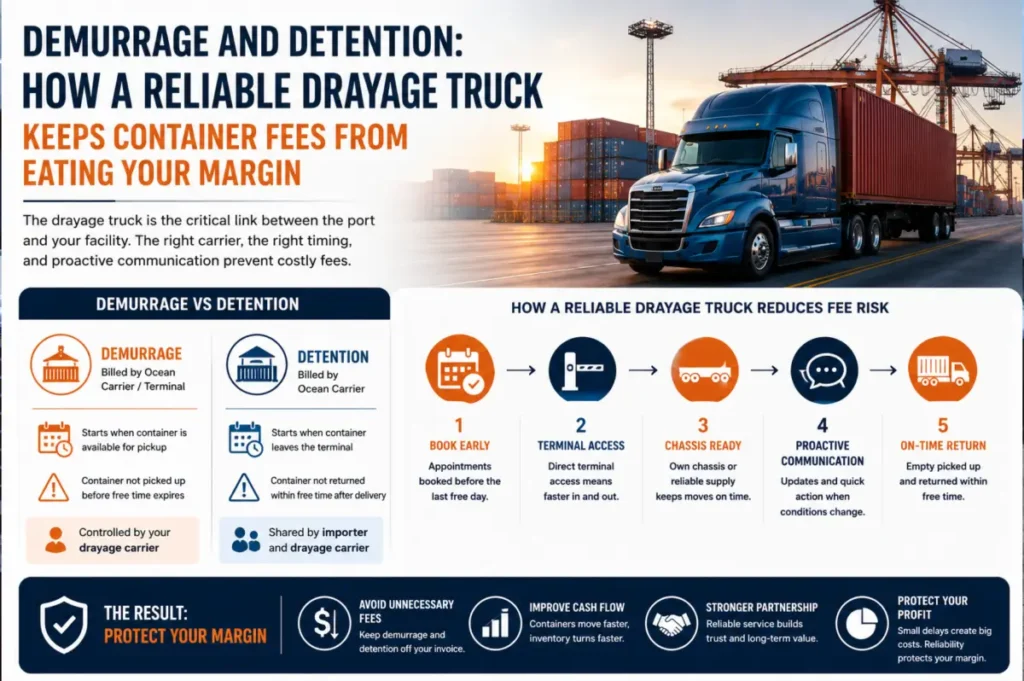
Demurrage is the fee charged by the ocean carrier when a container stays at the port terminal past the free time window. Detention is the fee charged when a drayage truck or container is held at the importer’s facility past the allowed unload time. A reliable drayage truck operation reduces both by booking terminal appointments ahead of the last free day, dispatching in-house drivers with direct terminal access, and communicating proactively when conditions change at the terminal or the delivery site. Most demurrage and detention charges are preventable with the right carrier and the right preparation.
Demurrage vs Detention: The Distinction That Actually Matters
These two terms are often used interchangeably, which causes confusion when an invoice arrives. They are separate charges from separate parties for separate reasons, and the drayage truck operation sits directly between both of them.
| Charge |
Who Bills It |
When the Clock Starts |
What Triggers It |
Who Controls It |
| Demurrage |
Ocean carrier or terminal |
When container is available for pickup |
Container not picked up before free time expires |
Primarily the drayage truck carrier: appointment timing and dispatch speed |
| Detention (equipment) |
Ocean carrier |
When container leaves the terminal |
Container not returned within the allowed free time after delivery |
Shared: importer’s unload speed and drayage carrier’s return scheduling |
| Per diem (rail) |
Rail carrier (CN / CP) |
When container arrives at the intermodal terminal |
Container not picked up before rail free time expires |
Primarily the drayage truck carrier: rail terminal appointment |
| Port storage |
Port authority or terminal operator |
After port storage-free period |
Container remains on terminal past the port’s own storage window |
Drayage carrier dispatch timing and appointment access |
The practical takeaway: demurrage sits with the drayage truck carrier’s ability to execute the pickup. Detention sits partly with the importer’s ability to unload and release the container on time. Both are worth understanding before the first container arrives.
Good to know: Ocean carrier free time and port storage free time are separate windows that can run simultaneously but are billed by different parties. A container can be clear of demurrage and still accumulating port storage charges if it sits on the terminal. Confirm both windows when you receive the Bill of Lading.
How the Drayage Truck Operation Determines Your Fee Exposure
The drayage truck move is where most controllable demurrage risk sits. Port conditions, vessel delays, and customs holds are partly outside your control. The appointment, the chassis, the dispatch, and the driver are not.
Here is where a drayage truck carrier either protects your margin or contributes to eroding it.
Appointment timing
The carrier books the terminal appointment before the last free day, not after the container is technically available. A drayage truck carrier that waits for you to prompt the appointment is already behind.
Terminal access
The drayage truck driver dispatched to your container has direct terminal access. New or infrequent carriers face longer gate queues and less reliable appointment windows than carriers with established terminal relationships.
Chassis availability
The carrier has its own chassis or a reliable supply arrangement. A drayage truck that arrives at the terminal without a chassis because the pool is short leaves the container sitting and the clock running.
Proactive communication
The carrier communicates when conditions change. If a customs hold extends pickup by a day, the right drayage truck operator calls you and the terminal simultaneously to adjust the appointment rather than letting it lapse.
Return tracking
The carrier tracks return scheduling on the detention side. After delivery, the drayage truck needs to pick up the empty container and return it to the terminal within the ocean carrier’s free return window. Carriers with in-house drivers manage this end of the clock as deliberately as the pickup end.
What Reliability Actually Looks Like in a Drayage Truck Operation
Reliability is not a marketing claim. For a drayage truck operation, it shows up in a few specific things that are worth asking about before the first move.
In-house drivers versus brokered capacity
A
drayage company with in-house drivers controls its own dispatch decisions. When the terminal changes a gate window with two hours’ notice, the in-house dispatcher reaches the driver directly and adjusts. When the capacity is brokered, there is a middle layer between the instruction and the truck. That middle layer shows up on your demurrage invoice.
Appointment history at the specific terminal
GTA intermodal terminals assign appointment windows on a first-come basis, and established carriers get earlier slots. A drayage truck carrier with a long appointment history at the CN Brampton terminal or the CP Vaughan facility can typically get a pickup window closer to the free time deadline than a carrier newer to that terminal’s system.
Chassis supply
A drayage truck without a chassis does not move the container. During the October-December peak import season, pool chassis in the GTA run short regularly. A carrier that carries even a partial fleet of its own chassis is less exposed to pool shortages than one that depends entirely on the shared pool.
Communication standards
The best drayage truck operations notify you before you have to ask. When a customs hold comes in, you get a call. When the terminal adjusts an appointment, you get the updated window. When the container return is scheduled, you get the confirmation. Reactive communication, where you find out about a delay after it has already caused a fee, is a carrier performance issue, not a logistics inevitability.
Good to know: Free time periods vary by ocean carrier, and some carriers have begun tightening them to two to four days on high-volume lanes. The drayage truck appointment needs to be booked before free time expires, not on the last day. Ask your carrier how far in advance they schedule the appointment relative to the expected discharge date.
What Importers Control: The Non-Drayage Factors in Demurrage and Detention
The drayage truck carrier is not the only variable. Importers who manage these items on their side reduce fee exposure significantly, regardless of which carrier they use.
- Customs timing. File the customs entry early. A customs hold after vessel arrival is the single most common source of avoidable demurrage. Filing as soon as the commercial invoice is available, before the vessel docks, means clearance is in hand when the container becomes available.
- Free time communication. Know your free time window before the vessel arrives. This is on the Bill of Lading. Share it with your drayage truck carrier when you book the move, not after the container is discharged.
- Dock scheduling. Have an unloading appointment ready before the drayage truck delivers. Detention charges on the importer’s side accumulate when the driver waits at the dock. Having a dock time confirmed before the truck arrives eliminates this exposure.
- Return deadline awareness. Confirm the return deadline with the carrier. Once the container is delivered, ask when it needs to be back at the terminal. Build that date into your unloading schedule so the drayage truck can pick up the empty on time.
How S&R Trucking Manages Drayage Truck Operations to Protect Your Margin
S&R Trucking provides
drayage truck service in Ontario from its base in Kleinburg, operating close to the major GTA intermodal terminals on the CN and CP network. S&R has been part of an intermodal network since 1992 and dispatches in-house drivers for container drayage moves across the GTA and into Ontario distribution corridors.
When you book a drayage truck move with S&R, we confirm the free time window, pre-book the terminal appointment, and notify you when any condition changes before the move. We do not wait for you to ask where your container is. If a customs hold comes in or the terminal adjusts a window, you hear from us first.
For importers managing regular container volumes and tired of unpredictable demurrage invoices,
get a quote from S&R Trucking. Call 905-951-2951 or reach us through the contact page. For the full picture on what causes drayage delays and how to avoid them at each step, see our breakdown of
container drayage delays and demurrage fees.
Key Takeaways
- Demurrage and detention are separate charges from separate parties: demurrage from the ocean carrier for containers that overstay the terminal, detention for containers held too long at the delivery site. A drayage truck operation sits between both.
- The drayage truck carrier controls the most preventable part of demurrage exposure: appointment timing, terminal access, chassis availability, and in-house dispatch speed.
- In-house drivers give the drayage truck operation direct dispatch control. Brokered capacity adds a layer that slows response at the moments when the clock is running.
- Ocean carrier free time and port storage free time are separate windows that can run simultaneously. Confirm both when you receive the Bill of Lading.
- GTA chassis pool shortages during peak season (October-December) are a real risk. Ask any drayage truck carrier whether they carry their own chassis or depend entirely on the pool.
- Importers reduce fee exposure by filing customs early, sharing the free time window at booking, having a dock appointment ready for delivery, and confirming the container return deadline.
- Reactive communication from a carrier, where you hear about a delay after the fee has already started, is a carrier performance issue, not an inevitable part of drayage.
- S&R Trucking provides drayage truck service from Kleinburg, Ontario, with in-house dispatch, consistent GTA terminal access, and proactive communication on every move.
Frequently Asked Questions
What is a drayage truck?
A drayage truck is a short-haul truck that moves shipping containers between intermodal terminals, such as port facilities and rail ramps, and the final delivery address or the next leg of transport. In the Canadian import context, drayage trucks handle the pickup from GTA intermodal rail terminals and the delivery to warehouses and distribution centres across Ontario. The drayage truck move is the road leg of an intermodal container shipment.
How does a drayage truck cause or prevent demurrage fees?
Demurrage fees accumulate when a container is not picked up from the terminal before the ocean carrier’s free time expires. The drayage truck carrier controls the critical variables: when the terminal appointment is booked, whether the driver has consistent access to the terminal, and whether the chassis is available on pickup day. A carrier that books appointments early, dispatches in-house drivers, and carries its own chassis prevents most controllable demurrage. A carrier that depends on brokered capacity and pool chassis introduces delays the importer ends up paying for.
What is the difference between demurrage and detention on a drayage truck move?
Demurrage is the fee charged by the ocean carrier when the container is not removed from the terminal before free time expires. It is a fee for occupying terminal space. Detention is the fee charged when the container, once removed from the terminal, is not returned within the allowed free time. On a drayage truck move, demurrage is the pickup-side clock and detention is the return-side clock. Both run against the drayage truck’s scheduling, but detention is also affected by how quickly the importer can unload and release the empty.
How do I reduce detention charges on drayage truck deliveries?
Have a dock appointment confirmed before the drayage truck arrives. Detention charges accumulate when the driver is waiting at your facility without a dock window, often at a daily or per-hour rate. Confirm the ocean carrier’s free return window when the container is delivered, build the return date into your unloading schedule, and ask your drayage truck carrier to confirm when they will pick up the empty. A carrier who tracks the return deadline as actively as the pickup deadline eliminates most detention exposure.
What makes a drayage truck carrier reliable for high-volume GTA container lanes?
Look for in-house drivers rather than brokered capacity, consistent appointment access at the specific GTA terminal your containers use, at least partial chassis ownership, and a demonstrated standard of proactive communication when conditions change. Ask the carrier how they handle a customs hold, how far in advance they book the terminal appointment, and who your direct dispatch contact will be. These specifics differentiate a carrier that manages fee exposure from one that just moves the container when conditions are ideal.
How much do demurrage and detention charges typically cost?
Rates vary by ocean carrier, but demurrage charges on GTA lanes typically start at CAD $75-$150 per container per day after free time expires and escalate in tiers after the first few days. Detention rates vary similarly. Port storage charges, which run separately from carrier demurrage, add another layer. A single container held at a GTA terminal for five days past free time can accumulate $500-$1,000 or more in combined charges depending on the carrier and terminal. Exact rates are on the carrier’s tariff or the Bill of Lading, and it is worth confirming them before the container arrives.
S&R Trucking TeamSince 1992, S&R Trucking has been one of Ontario's leading intermodal carriers, combining FTL, LTL, drayage, flatbed and secure storage with 24/7 dispatch across Canada and North America.
Ready to Move Your Freight?
Talk to a real dispatcher today and get a free, no-obligation quote for your next shipment.
REQUEST A FREE QUOTES&R Trucking TeamSince 1992, S&R Trucking has been one of Ontario's leading intermodal carriers, combining FTL, LTL, drayage, flatbed and secure storage with 24/7 dispatch across Canada and North America.
Ready to Move Your Freight?
Talk to a real dispatcher today and get a free, no-obligation quote for your next shipment.
REQUEST A FREE QUOTE
 August 26, 2026 - By : S&R Trucking Team

2 Comments
Container Drayage and Canada’s Trade Shift: How Ontario Shippers Can Plan for New Markets - Srtrucking
[…] where a lot of cost and delay hides. Terminals give you a limited window of free time. Miss it, and demurrage and detention fees start adding up by the day. If your business starts exporting more to Europe, you will likely deal […]
Container Terminal Pickup Documents Ontario: Drayage Checklist
[…] Demurrage at Ontario’s intermodal terminals can accumulate per container per day after free time expires. Several days of charges caused by one unconfirmed document can be costly. Learn more about drayage demurrage and detention charges. […]