When a trade relationship changes overnight, container drayage is one of the first places Ontario shippers feel it. In late August 2026, trade talks between Canada and the US broke down and new 50% tariffs hit about $20 billion in Canadian goods. A few weeks later, the European Commission proposed a closer partnership with Canada. For importers and exporters around the GTA, the question is simple: if more of your freight starts moving by ocean container instead of across the border by truck, is your supply chain ready?
Quick answer: As Canada looks to sell more to markets outside the US, more Ontario freight is likely to move in ocean containers through the Port of Montreal and inland intermodal terminals. Container drayage is the truck leg that moves those boxes between the terminal and your dock. Shippers should line up reliable drayage services, understand free time and demurrage, and plan storage so containers keep moving when schedules change.
What happened: tariffs, talks and a new European offer
Here is the short version of a fast-moving year.
On August 22, 2026, Canada-US trade talks collapsed. The US applied 50% tariffs to roughly $20 billion in Canadian goods, including electronics, industrial machinery and dairy, on top of existing tariffs on steel, lumber and autos. Canada announced matching counter-tariffs starting September 8.
Reporting on the talks said the US had asked for a right of first refusal on Canadian minerals, a demand industry experts called unworkable. Canada supplied about 17.7% of US metals and minerals imports in 2024, worth roughly $43.5 billion.
On September 16, 2026, European Commission President Ursula von der Leyen proposed making Canada the European Union’s first associate member. A Canada-EU summit in Montreal in late October is expected to shape what that means in practice. At the same time, Prime Minister Mark Carney has said Canada aims to double its exports to markets beyond the US.
Good to know: The US is still Canada’s largest trading partner by a wide margin. Trade diversification is a gradual shift, not a switch. Most shippers will run both cross-border and overseas lanes for years.
Why a trade shift puts container drayage at the centre
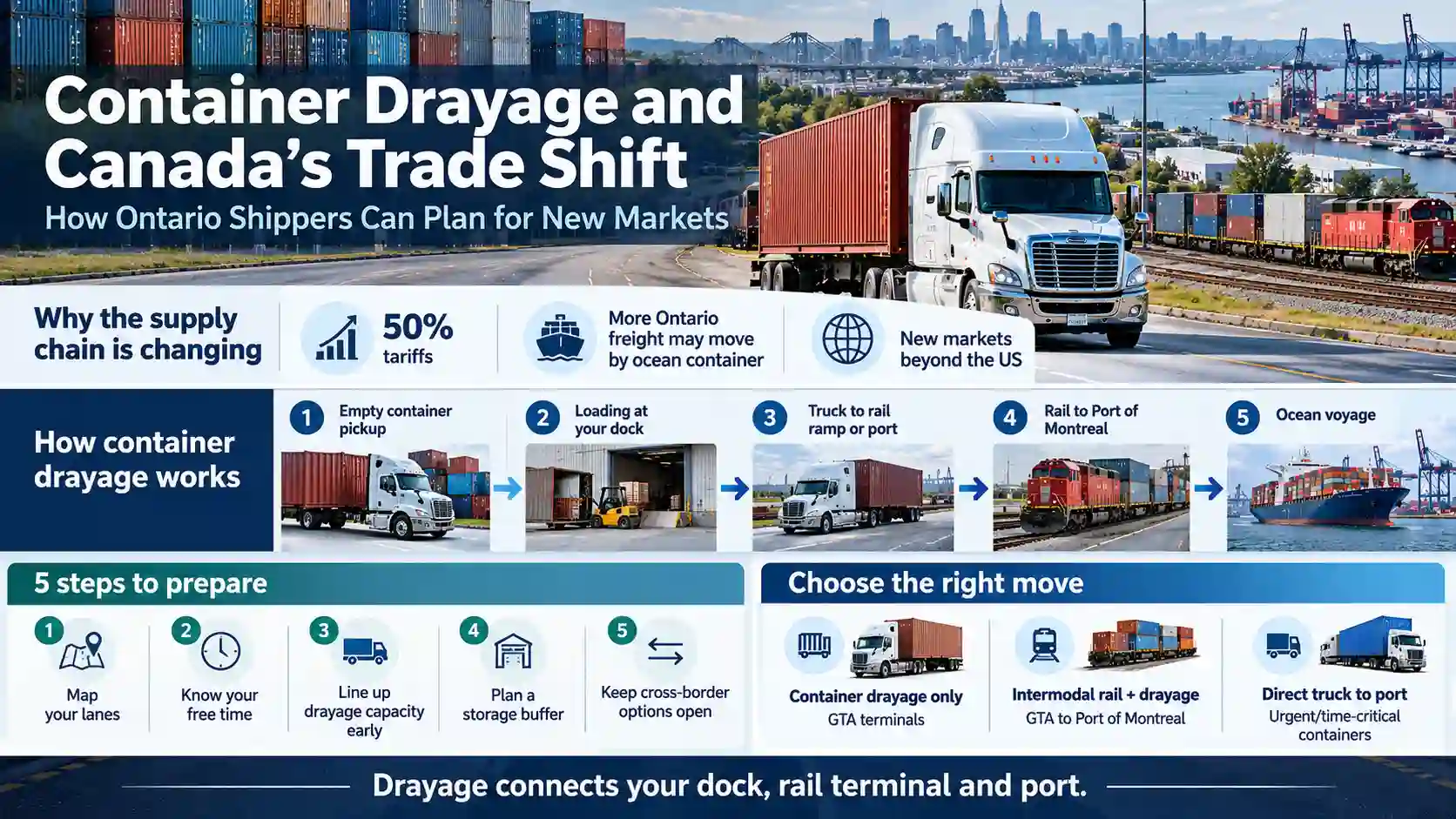
Freight going to the US usually travels by truck or rail straight across the border. Freight going to Europe, Asia or other overseas markets travels in ocean containers. That box has to get from your plant to a port or rail terminal first, and back again on the import side.
That truck move is container drayage. It is short distance, but it is where a lot of cost and delay hides. Terminals give you a limited window of free time. Miss it, and demurrage and detention fees start adding up by the day.
If your business starts exporting more to Europe, you will likely deal with:
- More export containers moving from Ontario plants to the Port of Montreal or to intermodal terminals in the GTA
- More intermodal rail moves, with drayage on one or both ends
- Tighter booking windows, since vessels and rail cuts run on fixed schedules
- More paperwork checks before a container is released or accepted
How container drayage fits into an export move
| Leg |
Who moves it |
What can go wrong |
| Empty container pickup |
Drayage carrier |
Equipment shortages, wrong container size |
| Loading at your dock |
Your team |
Late loading, weight or seal errors |
| Truck to rail ramp or port |
Drayage carrier |
Terminal cut-off times missed |
| Rail to Port of Montreal |
Intermodal rail |
Rail congestion, schedule changes |
| Ocean voyage |
Shipping line |
Vessel delays, rolled bookings |
Each handoff is a chance for delay. Good drayage services reduce the risk on the legs you control, and good container transportation planning keeps one late leg from wrecking the whole schedule.
Five steps to prepare your supply chain
- Map your lanes. List which products might shift to overseas buyers and which ports or terminals they would use. For most Ontario shippers, that means the Port of Montreal by truck or through intermodal rail from GTA terminals.
- Know your free time. Ask your shipping line and terminal how many free days you get and what demurrage and detention cost after that. Build this into your pricing, and use our last free day planning guide to set pickup targets.
- Line up drayage capacity early. When volumes jump, drayage companies fill up fast, especially around the GTA terminals. If you are comparing carriers, here is why two drayage quotes can look so different. Set expectations with your carrier before your first export booking, not the week the vessel leaves.
- Plan a buffer. Rolled bookings and rail delays happen. Short-term storage near the GTA lets you pull a container off the terminal before fees start, then deliver when the plan firms up.
- Keep cross-border options open. The US remains a major market. Keep your full truckload and LTL lanes running while you test new overseas customers.
Container transportation choices: drayage, intermodal rail or direct truck
| Option |
Best for |
Trade-off |
| Container drayage only |
GTA import and export moves to nearby terminals |
Short distance, but tight terminal windows |
| Intermodal rail plus drayage |
Long moves between the GTA and the Port of Montreal |
Usually lower cost on long distance, less schedule flexibility |
| Direct truck to port |
Urgent or time-critical containers |
Faster door to port, higher cost per kilometre |
There is no one right answer. For a deeper look at the rail option, see when combining rail and truck beats long-haul trucking alone. The best mix depends on how urgent the freight is, how much volume you move and how close you are to a terminal. Our container transportation page covers these options in more detail, and most exporters end up using a mix of all three.
How S&R Trucking helps with container drayage
S&R Trucking has been part of an intermodal network since 1992, and our team is based at 10481 Highway 50 in Kleinburg, on the northwest edge of the GTA. We move containers between Toronto-area intermodal terminals, the Port of Montreal and shipper docks across Ontario, and our intermodal transportation service covers the rail leg in between.
Our drayage services focus on getting containers off the terminal inside free time and communicating clearly when something changes. If you need a place to hold freight, our storage solutions can bridge the gap. For freight that still heads across the border or around Ontario by road, we also run full truckload services.
If your business is planning for new export markets, call S&R Trucking at 905-951-2951 or get a quote for your next container drayage move.
What to watch next
Several things will shape freight flows over the coming months: the outcome of the Canada-EU summit in Montreal, any new round of Canada-US talks, and how fast new port and corridor projects move under Bill C-39, the Building Canada Strong Act. Domestic building will also change freight patterns inside Canada, which we cover in our companion post on flatbed trucking and Canada’s build push. None of these will change your lanes overnight, but each can shift volumes at the terminals Ontario shippers rely on.
The safest approach is to build a supply chain that can flex. That means a dependable drayage partner, a clear view of your terminal costs and room to hold freight when the plan changes.
Key Takeaways
- Canada-US trade talks collapsed on August 22, 2026, and the US applied 50% tariffs to about $20 billion in Canadian goods.
- On September 16, 2026, the European Commission proposed making Canada the EU’s first associate member, with a Canada-EU summit set for Montreal in late October.
- Selling more to overseas markets means more ocean containers, which makes container drayage a bigger part of Ontario supply chains.
- Container drayage moves containers between terminals, ports and your dock, and it is where demurrage and detention costs often start.
- Container transportation for export usually combines drayage, intermodal rail and sometimes direct truck moves.
- Most Ontario export containers bound for Europe will move through the Port of Montreal, by truck or through intermodal rail.
- Booking drayage services early and knowing your free time protect your margins.
- Short-term storage gives you a buffer when bookings roll or rail runs late.
- The US remains Canada’s largest market, so cross-border truck lanes still matter.
Frequently Asked Questions
What is container drayage?
Container drayage is the short-distance truck move that carries a shipping container between a port or rail terminal and a shipper’s or receiver’s location. It connects ocean shipping and intermodal rail to the final pickup or delivery point.
How do US tariffs affect container drayage in Ontario?
Tariffs do not change how drayage works, but they can change where freight goes. If Canadian businesses sell more overseas, more freight moves in ocean containers through ports like Montreal, which increases demand for drayage services around Ontario terminals.
What is the difference between drayage and intermodal rail?
Intermodal rail moves containers long distances by train, such as between the GTA and the Port of Montreal. Drayage is the truck leg on either end, moving the container between the rail terminal and your dock.
How can I avoid demurrage fees on my containers?
Know your terminal’s free time, book a drayage carrier before the container arrives or before your export cut-off, and have your documents ready. If your site cannot receive the container on time, move it to short-term storage instead of leaving it at the terminal.
What should I look for in drayage companies near Toronto?
The best drayage companies for export work have a few things in common. Look for a carrier with terminal experience, clear communication, access to storage and the ability to handle both import and export moves. A carrier that also offers full truckload service is useful if your freight splits between overseas and cross-border lanes.Kugan KathirSince 1992, S&R Trucking has been one of Ontario's leading intermodal carriers, combining FTL, LTL, drayage, flatbed and secure storage with 24/7 dispatch across Canada and North America.
Ready to Move Your Freight?
Talk to a real dispatcher today and get a free, no-obligation quote for your next shipment.
REQUEST A FREE QUOTEKugan KathirSince 1992, S&R Trucking has been one of Ontario's leading intermodal carriers, combining FTL, LTL, drayage, flatbed and secure storage with 24/7 dispatch across Canada and North America.
Ready to Move Your Freight?
Talk to a real dispatcher today and get a free, no-obligation quote for your next shipment.
REQUEST A FREE QUOTE
 October 2, 2026 - By : Kugan Kathir

Leave a comment