If you ship steel, lumber or heavy equipment out of Ontario, flatbed trucking is about to get busier, and the reason is in Ottawa, not on the 401. Between the federal Buy Canadian Policy and new legislation aimed at getting ports, corridors and major projects built faster, more Canadian-made materials are going to be moving to Canadian job sites. Shippers who plan their open-deck capacity now will have an easier year than shippers who wait for the first tight week.
Quick answer: Canada’s push to build at home, backed by the Buy Canadian Policy and Bill C-39, is set to raise demand for flatbed trucking in Ontario because more domestic steel, aluminum and wood will travel from mills and yards to construction and infrastructure sites. Shippers should book flatbed capacity early, confirm securement and permit needs up front, and work with a carrier that can also handle full truckload and storage when schedules slip.
What changed: Buy Canadian rules and a faster build agenda
Three policy moves are shaping freight demand in 2026.
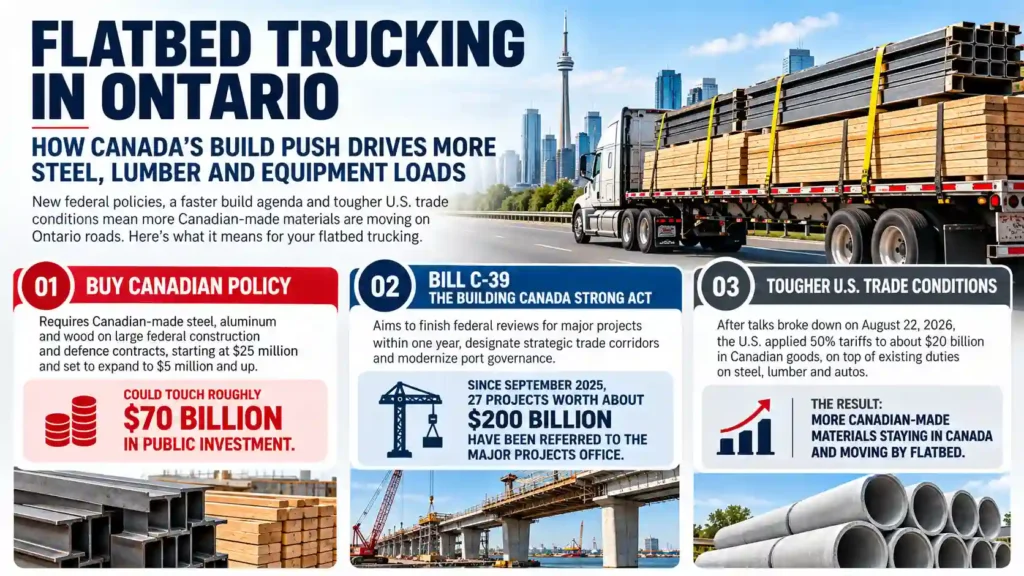
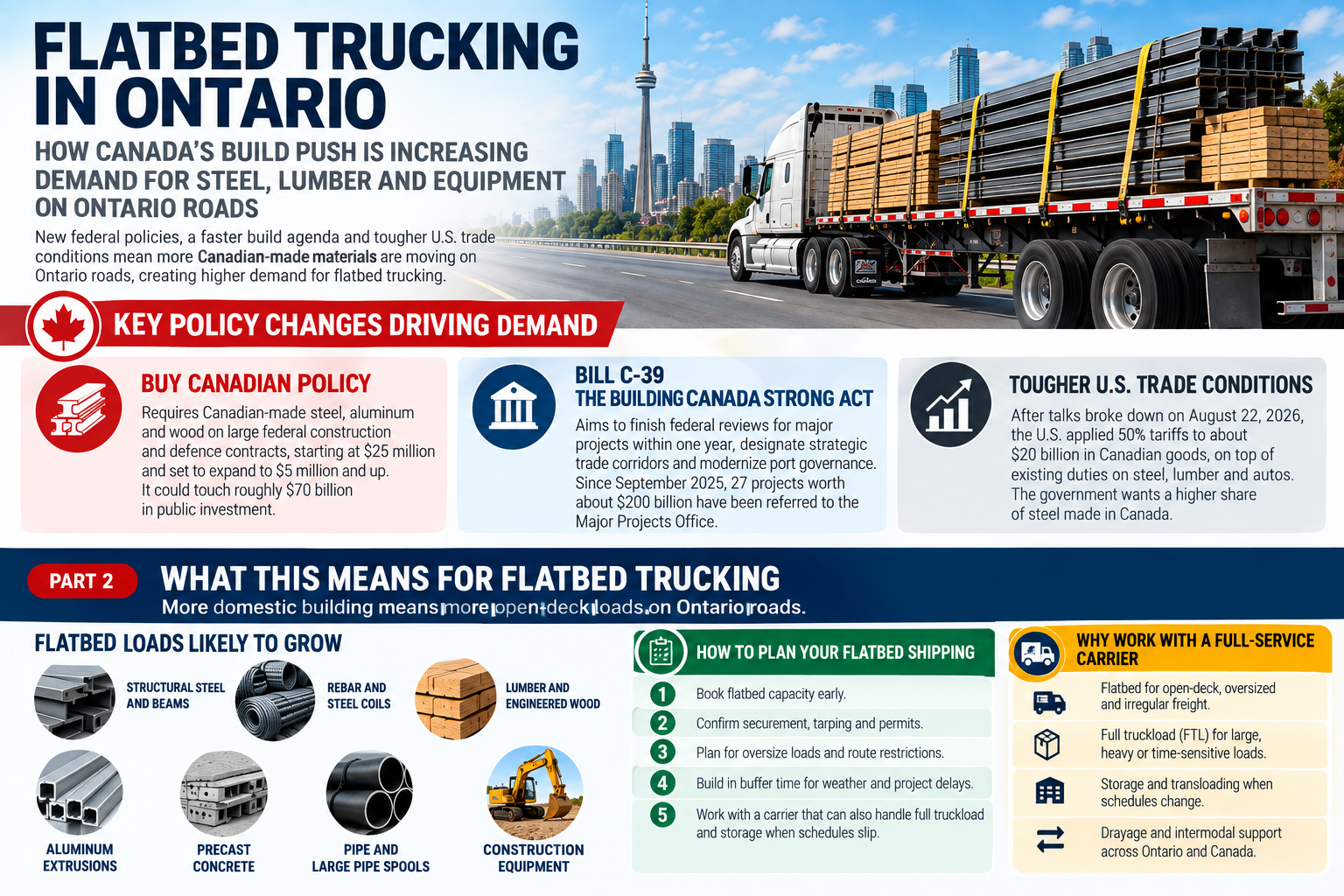
First, the federal Buy Canadian Policy took effect on December 16, 2025. It requires Canadian-made steel, aluminum and wood on large federal construction and defence contracts, starting at $25 million and set to expand to contracts of $5 million and up. The government says it could touch roughly $70 billion in public investment.
Second, on September 21, 2026, Ottawa introduced Bill C-39, the Building Canada Strong Act. It aims to finish federal reviews for major projects within one year, designate strategic trade corridors and modernize port governance. Since September 2025, 27 projects worth about $200 billion have been referred to the federal Major Projects Office.
Third, trade with the US got harder. After talks broke down on August 22, 2026, the US applied 50% tariffs to about $20 billion in Canadian goods, on top of existing duties on steel, lumber and autos. Prime Minister Mark Carney has said only about 40% of the steel bought in Canada is made in Canada, and the government wants that number to climb.
Good to know: The Buy Canadian Policy applies to where materials are made or processed, not just who sells them. That means more loads starting at Canadian mills, fabricators and sawmills.
Why more domestic building means more flatbed trucking
Most building materials that go into a bridge, a port expansion or a housing project do not fit in a dry van. Structural steel, rebar bundles, lumber packs, precast concrete, pipe and construction equipment all load from the side or top. That is open-deck work.
When federal projects have to source Canadian materials, the freight pattern shifts. Instead of steel crossing the border by rail or truck from US suppliers, more of it moves from Ontario and Quebec mills to fabricators, and then from fabricators to job sites. Each of those legs is a candidate for flatbed trucking.
For Ontario shippers, that means competition for the same trucks. Flatbed shipping capacity is always tighter than van capacity, and construction season makes it tighter again. When federal projects and private builders chase the same open-deck trucks, flatbed trucking rates and lead times both feel it.
Which flatbed trucking loads are likely to grow first
| Material |
Typical flatbed setup |
What to plan for |
| Structural steel and beams |
Flatbed or step deck, chains and edge protection |
Length, overhang and piece count on the bill of lading |
| Rebar and steel coils |
Flatbed with coil racks or cradles |
Weight distribution and securement points |
| Lumber and engineered wood |
Flatbed with straps and tarps |
Tarping to keep product dry and grade intact |
| Aluminum extrusions |
Flatbed with tarps and dunnage |
Scratch protection and careful handling |
| Construction equipment |
Step deck or specialized trailer |
Height, oversize permits and escort rules |
| Precast and pipe |
Flatbed with blocking |
Load plans that stop rolling or shifting |
This is where experienced flatbed trucking companies in Ontario earn their rate. The load plan matters as much as the truck, and good flatbed shipping starts with an honest description of the freight.
How to plan your flatbed freight shipping in a busier market
When demand rises, the shippers who get covered are the ones who make a load easy to say yes to. Here is a simple process that works.
- Give the full picture on the first call. Share dimensions, weights, piece counts, pickup and delivery windows and whether the site has a forklift or crane. Missing details cause the most delays in flatbed freight shipping.
- Flag oversize early. Anything over legal width, height or length in Ontario needs an oversize/overweight permit from the province, and some moves need escorts or time-of-day limits. Permits take time, so raise it before the booking, not after.
- Confirm tarping and securement. Lumber, aluminum and finished steel often need tarps. Ask your carrier how they secure your specific product and whether edge protection is included.
- Book repeat lanes ahead. If your project runs for months, set up a regular schedule with your carrier instead of posting loads week by week. Steady flatbed freight shipping is easier to cover than a string of one-off loads.
- Plan for job site delays. Sites are not always ready. If your quantities are too big for LTL but will not fill a trailer, ask about partial load solutions. Ask whether your carrier can hold material in storage or re-deliver so you avoid paying a truck to sit.
Flatbed or full truckload: choosing the right trailer
Not every building product needs an open deck. Boxed fixtures, palletized fasteners, insulation and finished goods usually ship better in an enclosed trailer.
A simple way to decide: if the load has to go on from the side or top, is oversize or oddly shaped, or only needs tarps for weather, it belongs on a flatbed or step deck. If it is palletized, boxed or needs to stay fully enclosed and dry, a dry van on a full truckload is the better fit. Steel, lumber, equipment and pipe lean flatbed. Fixtures, insulation, fasteners and packaged goods lean dry van. If you are not sure what counts as a full truckload, our guide to full truckload services walks through it.
Many project shippers need both: open decks for steel and lumber, and full truckload shipping for everything that travels boxed or palletized. Using one carrier for flatbed trucking and full truckload shipping keeps your schedule in one place and cuts down on the handoffs that cause missed deliveries.
How S&R Trucking handles flatbed loads in Ontario
S&R Trucking works out of 10481 Highway 50 in Kleinburg, on the northwest edge of the GTA, which keeps the 401 corridor, the Golden Horseshoe and lanes into Quebec within easy reach. Our team handles flatbed services for steel, lumber, building materials and equipment, and we plan securement and permits before the truck is dispatched.
When a job site is not ready, our storage solutions give you a place to hold material instead of paying for waiting time. And if part of your project ships in containers through the Port of Montreal or Toronto terminals, our drayage services and intermodal transportation can move those boxes too.
Have a project starting this fall or next spring? Call S&R Trucking at 905-951-2951 or request a quote and tell us what you are moving.
What this means for flatbed trucking over the next 12 months
Nobody can promise exactly how fast federal projects will move. Approvals, financing and trade talks all shift. What is clear is the direction: more Canadian materials, more domestic job sites and more pressure on open-deck capacity in Ontario.
The practical move is to treat flatbed trucking as a planned part of your project, not a last-minute call. If your business is also shifting toward overseas buyers, read our companion post on container drayage and Canada’s trade shift. Shippers who lock in a reliable carrier early tend to get better service when the market tightens.
Key Takeaways
- The federal Buy Canadian Policy, in effect since December 16, 2025, requires Canadian-made steel, aluminum and wood on large federal construction and defence contracts.
- Bill C-39, the Building Canada Strong Act, introduced September 21, 2026, aims to speed up major projects, trade corridors and port modernization.
- US tariffs of 50% on about $20 billion in Canadian goods, plus existing duties on steel and lumber, push more materials toward domestic use.
- More domestic building is likely to raise demand for flatbed trucking in Ontario, especially for steel, lumber, aluminum and equipment.
- Flatbed shipping capacity is tighter than van capacity, so booking early and sharing full load details matters.
- Oversize loads need Ontario permits, so flag dimensions before booking.
- Many projects need both flatbed and full truckload shipping, and one carrier for both reduces handoffs.
- Storage between pickup and delivery can save money when job sites run behind.
Frequently Asked Questions
Will the Buy Canadian Policy increase flatbed trucking demand in Ontario?
It is likely to. The policy requires Canadian-made steel, aluminum and wood on large federal construction and defence contracts, so more loads will move from Canadian mills and fabricators to Canadian job sites. Much of that material ships on open-deck trailers.
What types of freight need flatbed shipping?
Structural steel, rebar, coils, lumber, aluminum extrusions, precast concrete, pipe and construction equipment are common flatbed loads. Anything that must be loaded from the side or top, or that is too tall or wide for a dry van, usually needs a flatbed or step deck.
How early should I book flatbed freight shipping for a construction project?
For regular project deliveries, set up a schedule with your carrier as soon as you have dates, ideally a few weeks ahead. For oversize loads, add time for permits. Last-minute bookings are harder to cover during busy construction months.
What should I look for in flatbed trucking companies in Ontario?
Look for a carrier that asks detailed questions about your load, explains how it will secure and tarp your product, handles oversize permits and communicates clearly on delivery times. A carrier that also offers full truckload and storage is useful for project work.
Do US tariffs affect domestic flatbed trucking rates?
Tariffs do not set domestic freight rates directly. They can change where materials are sourced and shipped, which affects demand for trucks on certain lanes. When more freight shifts to domestic routes, open-deck capacity can tighten, especially in peak construction season.S&R Trucking TeamSince 1992, S&R Trucking has been one of Ontario's leading intermodal carriers, combining FTL, LTL, drayage, flatbed and secure storage with 24/7 dispatch across Canada and North America.
Ready to Move Your Freight?
Talk to a real dispatcher today and get a free, no-obligation quote for your next shipment.
REQUEST A FREE QUOTES&R Trucking TeamSince 1992, S&R Trucking has been one of Ontario's leading intermodal carriers, combining FTL, LTL, drayage, flatbed and secure storage with 24/7 dispatch across Canada and North America.
Ready to Move Your Freight?
Talk to a real dispatcher today and get a free, no-obligation quote for your next shipment.
REQUEST A FREE QUOTE

 October 2, 2026 - By : S&R Trucking Team

Leave a comment