Most containers moving into the GTA by rail land at one of two places: CN’s Brampton Intermodal Terminal or CP’s Vaughan Intermodal Terminal. Which one your container ends up at is decided by the ocean carrier and the routing on your bill of lading, not by you, but knowing the difference matters once the container is on the ground and you need to plan the drayage leg.
CN Brampton and CP Vaughan are both inland rail terminals serving the Greater Toronto Area, and both receive containers arriving from the Port of Montreal and other Canadian ports by intermodal rail. The practical differences for shippers come down to which rail network handles your container, where the terminal sits relative to your facility, and how that affects drayage distance and appointment booking. Neither terminal is better in an absolute sense. The one that matters to you is whichever one your container is assigned to.
Why the Terminal Matters for Your Container
Once your ocean container moves off the rail network onto the terminal grounds, a free time clock starts for that leg of the journey. That clock, the gate appointment system, and the drayage distance to your facility all depend on which terminal the container landed at. Knowing this in advance, rather than finding out once the container is already sitting on the ground, gives you time to book drayage and confirm receiving arrangements before the free time window closes.
For GTA importers, the terminal also affects which direction the drayage truck is coming from, which matters when you are scheduling around traffic on the 400 series highways during peak hours.
CN Brampton Intermodal Terminal
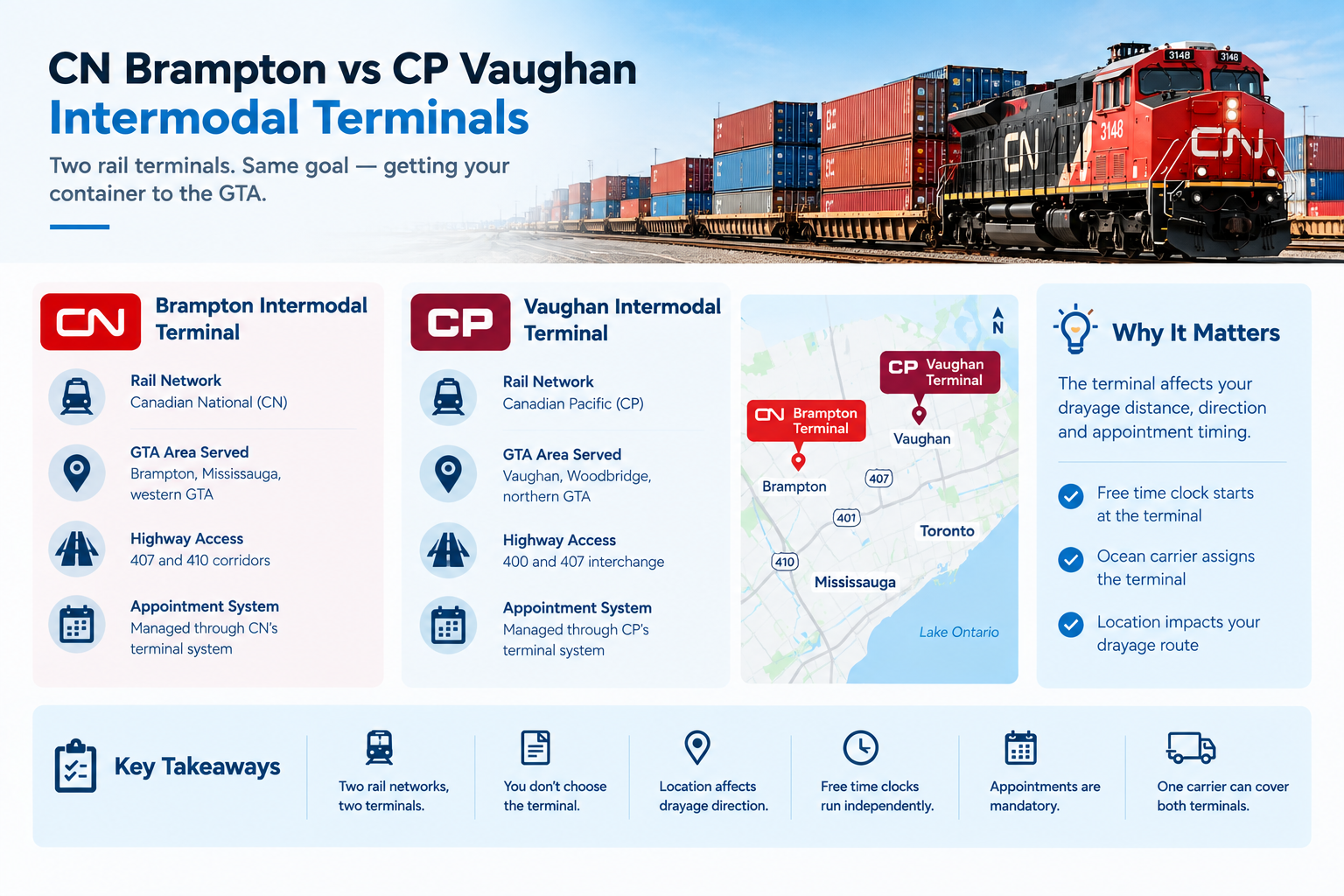
CN’s Brampton Intermodal Terminal is one of the primary inland rail hubs serving the GTA on the Canadian National network. Containers arriving from the Port of Montreal, and in some cases from western Canadian ports, are transferred onto CN’s rail network and moved inland to Brampton, where they are lifted off the rail cars and staged for pickup. From there, a drayage carrier picks up the container using a gate appointment booked through CN’s terminal system.
Because Brampton sits close to the 407 and 410 corridors, drayage moves from this terminal typically serve destinations across Brampton, Mississauga, Vaughan, and the western GTA efficiently. Appointment booking, container status, and free time information are managed through CN’s own systems, so your carrier or customs broker needs access to check release status before dispatching a truck.
CP Vaughan Intermodal Terminal
CP’s Vaughan Intermodal Terminal serves the same general function on the Canadian Pacific network. Containers moved by CP from the Port of Montreal or other origin points are transferred to rail, hauled inland, and staged at the Vaughan facility for pickup. As with CN Brampton, a drayage carrier needs a booked gate appointment and confirmed container release before picking up the box.
Vaughan’s location near the 400 and 407 interchange gives drayage carriers relatively direct access to the northern GTA corridor, including Vaughan itself, Woodbridge, and points north along the 400 toward Barrie, as well as south toward Toronto.
CN Brampton vs CP Vaughan at a Glance
The table below summarizes the main practical differences shippers ask about. Exact operational details change over time, so always confirm current appointment procedures and free time windows directly with your carrier or customs broker.
| Factor |
CN Brampton |
CP Vaughan |
| Rail network |
Canadian National (CN) |
Canadian Pacific (CP) |
| General GTA area served |
Brampton, Mississauga, western GTA |
Vaughan, Woodbridge, northern GTA |
| Highway access |
407 and 410 corridors |
400 and 407 interchange |
| Appointment system |
Managed through CN’s terminal system |
Managed through CP’s terminal system |
| Who assigns the terminal |
Ocean carrier and routing on the bill of lading |
Ocean carrier and routing on the bill of lading |
How to Find Out Which Terminal Your Container Will Use
You typically will not choose between CN Brampton and CP Vaughan. The ocean carrier selects the rail routing when the container is booked, based on their own network and interline agreements, and that decision shows up on the bill of lading or in the ocean carrier’s tracking portal once the vessel routing is confirmed.
The most reliable way to confirm which terminal your container will use is to check the bill of lading for the rail routing details, log into the ocean carrier’s tracking portal once the container is in transit, or ask your customs broker to confirm terminal assignment as soon as the vessel arrival is scheduled. Confirming this early gives your
drayage carrier time to plan the pickup route instead of scrambling once the container is already on the ground.
What This Means for Drayage Planning
Once you know which terminal your container is assigned to, the planning steps are the same at either facility: confirm the container has customs clearance and a terminal release, book a drayage pickup appointment before the last free day, and confirm your receiving dock or transload point is ready before the truck arrives. The terminal itself does not change what needs to happen. It changes where the drayage truck is coming from and how much lead time that adds to your schedule.
Good to know: The free time clock at the intermodal terminal is separate from any free time clock at the port of discharge, and the two can run at the same time. If your container moved from the Port of Montreal to CN Brampton or CP Vaughan, confirm both windows rather than assuming the terminal clock resets the port clock. Our guide on planning drayage around the last free day walks through how to track multiple free time clocks on one container.
How S&R Trucking Works With Both Terminals
S&R Trucking’s
intermodal transportation service covers drayage pickups from both CN Brampton and CP Vaughan, so the terminal your container lands at does not mean switching carriers or starting a new relationship. Our dispatchers coordinate directly with both terminal systems, track container release status, and book appointments ahead of the last free day so containers move without last minute scrambling.
For businesses that regularly import through both rail networks, having one carrier familiar with the appointment process, access routes, and typical wait times at both terminals removes a layer of coordination you would otherwise manage yourself. If you want to understand what the full move costs once the container is at the terminal, our guide on
shipping container transport cost breaks down the factors that affect the drayage leg specifically.
To arrange pickup from either terminal, call S&R Trucking at 905-951-2951 or reach us through our
contact page.
Key Takeaways
- Two rail networks, two terminals. CN Brampton Intermodal Terminal serves the CN network and CP Vaughan Intermodal Terminal serves the CP network. Both handle GTA bound containers arriving primarily from the Port of Montreal.
- You do not choose the terminal. The ocean carrier assigns the rail routing when the container is booked. Check your bill of lading or the ocean carrier’s tracking portal to confirm which terminal applies.
- Location affects drayage direction. CN Brampton sits near the 407 and 410 corridors, serving the western GTA well. CP Vaughan sits near the 400 and 407 interchange, serving the northern GTA corridor.
- Free time clocks run independently. The terminal free time clock is separate from any clock at the port of discharge. Track both, not just one.
- Appointments are mandatory at both. Neither terminal releases a container without a booked gate appointment and confirmed customs release.
- One carrier can cover both terminals. A drayage provider experienced with both CN and CP systems removes the need to manage two separate carrier relationships depending on where your container lands.
Frequently Asked Questions
Can I choose whether my container goes to CN Brampton or CP Vaughan?
No. The ocean carrier decides the rail routing based on their own network and interline agreements at the time the container is booked. You can confirm which terminal applies by checking the bill of lading or the ocean carrier’s tracking portal once the routing is set.
Is CN Brampton or CP Vaughan closer to Toronto?
Both terminals sit in the GTA and are within a reasonable drayage distance of most Toronto area facilities. CN Brampton is positioned to serve the western GTA efficiently, while CP Vaughan serves the northern GTA corridor well. The more relevant distance is between the terminal and your specific facility, which your drayage carrier can confirm.
Do CN Brampton and CP Vaughan have the same free time rules?
Both terminals require containers to be picked up within a free time window before per diem or storage charges begin, but the exact number of days and fee structure can differ between the two rail networks and can change over time. Confirm current free time terms with your carrier or the terminal directly for each shipment.
Does S&R Trucking handle drayage from both terminals?
Yes. S&R Trucking’s intermodal transportation service covers container pickups from both CN Brampton and CP Vaughan, along with delivery across the GTA and into surrounding Ontario. Call 905-951-2951 to arrange a pickup from either terminal.
What happens if my container misses its terminal appointment?
Missing a booked gate appointment usually means the slot is lost and a new appointment needs to be booked, which can push your pickup back and add to the risk of running past the free time window. Confirming appointment details and building in a buffer before the deadline helps avoid this.
S&R Trucking TeamSince 1992, S&R Trucking has been one of Ontario's leading intermodal carriers, combining FTL, LTL, drayage, flatbed and secure storage with 24/7 dispatch across Canada and North America.
Ready to Move Your Freight?
Talk to a real dispatcher today and get a free, no-obligation quote for your next shipment.
REQUEST A FREE QUOTES&R Trucking TeamSince 1992, S&R Trucking has been one of Ontario's leading intermodal carriers, combining FTL, LTL, drayage, flatbed and secure storage with 24/7 dispatch across Canada and North America.
Ready to Move Your Freight?
Talk to a real dispatcher today and get a free, no-obligation quote for your next shipment.
REQUEST A FREE QUOTE
 September 25, 2026 - By : S&R Trucking Team

Leave a comment