Intermodal freight tracking in Canada means following your container across three separate legs. Losing visibility at any stage can cost you time, money, and unnecessary calls to carriers who may not have the latest information about your shipment. If you ship through CN Brampton or CP Vaughan, you may have experienced a situation where your container was technically “in transit” but nobody could tell you exactly which terminal it was at or when it would be ready for pickup.
Tracking has improved significantly over the last few years. However, information is still spread across multiple portals and carriers, and there is not always a single dashboard available when you book an intermodal shipment. You may need to piece the information together yourself unless your drayage carrier manages the process for you.
This guide explains how tracking works at each stage of the intermodal chain in Canada, what information you need to have ready, and where tracking gaps commonly occur.
At a glance: Intermodal freight tracking in Canada covers three separate legs. The ocean carrier tracks your container at the port, CN or CP Rail tracks it across the railway network, and your drayage carrier manages the final pickup and delivery to your facility. To track a shipment, you generally need the container number, booking reference, and bill of lading number. Most shippers use multiple portals, including CN’s online tracking, CP Rail’s customer portal, and the ocean carrier’s website. The biggest visibility gaps often occur when responsibility passes from one carrier to another.
Tracking Intermodal Freight Means Following Three Separate Legs
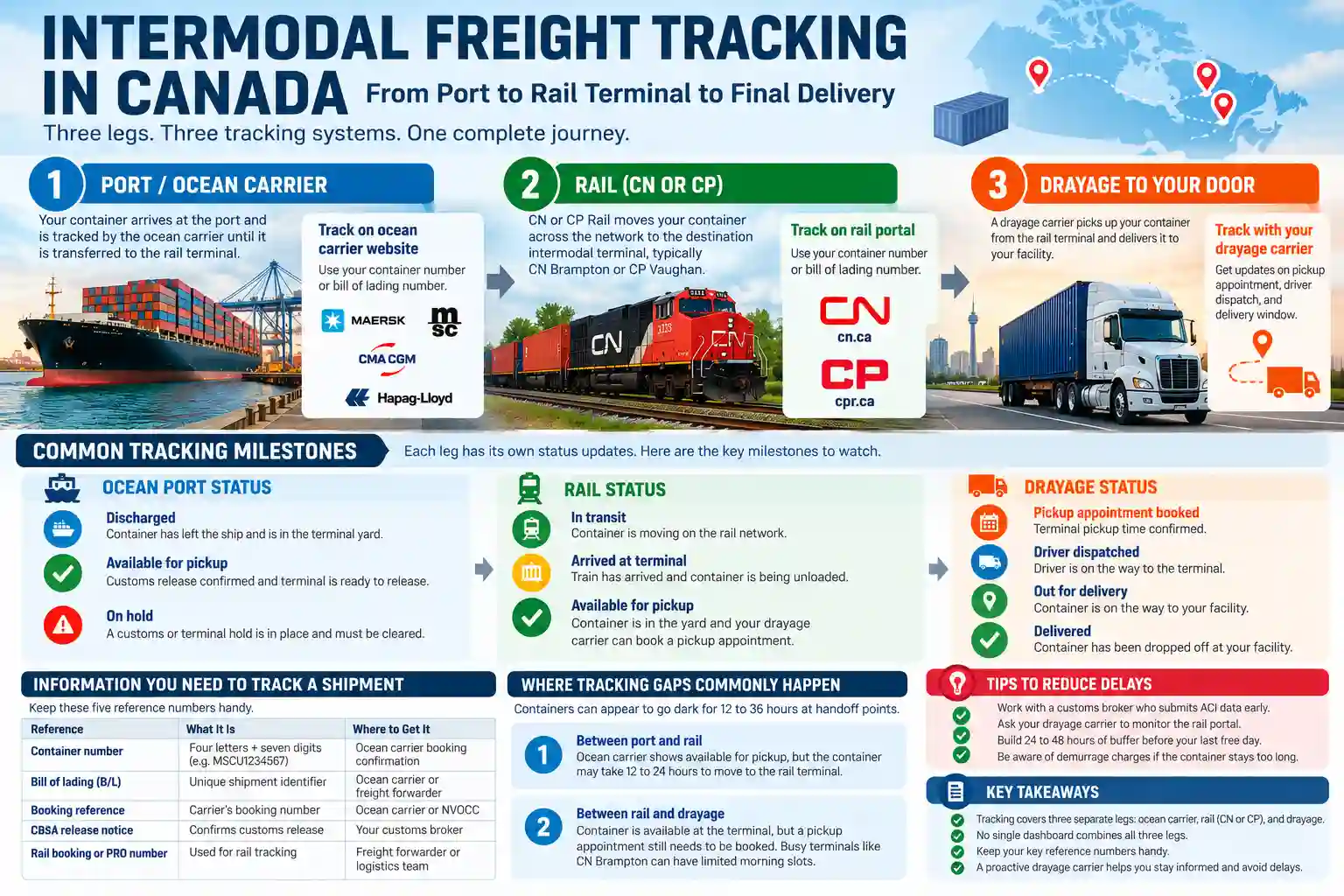
Intermodal freight tracking is not a single system. It involves three participants: the ocean carrier, the railway, and the drayage truck. Each participant controls a different leg of the journey and uses its own tracking system.
The three legs work as follows:
- Port and ocean carrier leg: Your container arrives at the Port of Montreal, the Port of Halifax, or a US gateway port. It remains under the ocean carrier’s tracking until it is transferred to the rail network.
- Rail leg: CN Rail or CP Rail takes over. The container moves by train to the destination intermodal terminal, typically CN Brampton (BIFT) or CP Vaughan for Ontario-bound freight.
- Drayage leg: A drayage carrier picks up the container from the rail terminal and delivers it to your facility.
Visibility gaps most often appear at the handoff points between the port and rail stages, and between the rail and drayage stages. Containers can appear to go “dark” for 12 to 36 hours while tracking systems update and physical movement catches up with the available data.
Leg 1: Tracking Your Container at the Ocean Port
Your ocean carrier, such as Maersk, MSC, CMA CGM, or Hapag-Lloyd, provides container tracking through its website. You can generally search using your container number or bill of lading number. Most carriers update shipment statuses after a container is discharged from the vessel.
The main status milestones to watch are:
- Discharged: The container has been unloaded from the ship and is in the terminal yard.
- Available for pickup: The required customs release has been confirmed and the terminal is ready to release the container, subject to any remaining terminal requirements.
- On hold: A customs or terminal hold is in place and must be cleared before your drayage driver can collect the container.
Once the container shows as available and customs clearance is confirmed, tracking responsibility may shift to the railway as the container moves through the intermodal network.
Good to know: The “available for pickup” status on your ocean carrier’s portal does not necessarily mean the container has physically arrived at the CN or CP rail terminal. There may be a delay of 12 to 24 hours before the next stage is reflected in the tracking system. Do not book a drayage appointment based on the ocean carrier’s status alone. Confirm availability through the relevant rail portal.
Leg 2: Tracking on the Rail: CN and CP Portals
Once your container is on the rail network, CN Rail and CP Rail provide shipment tracking through their respective customer portals.
CN Rail customers can track shipments through
CN’s official website using the container number or bill of lading number. For Ontario importers, CN Brampton, also known as the Brampton Intermodal Terminal or BIFT, is an important destination. CN provides estimated arrival windows, but these can change with rail congestion. Check the status 24 to 48 hours before the expected arrival date rather than relying solely on an earlier estimate.
CP Rail customers can track shipments through
CP’s official website. CP Vaughan, also known as Vaughan Intermodal Terminal, handles a significant share of Ontario container traffic moving on the CP network. The portal provides estimated arrival updates and information about when a container becomes available for pickup.
What “Available for Pickup” Actually Means at the Rail Terminal
A container showing as “available” on the rail portal generally means the train has arrived, the container has been unloaded, and it has been placed in the terminal yard. Your drayage carrier can then arrange a pickup appointment, subject to terminal requirements and appointment availability.
This does not mean the appointment will be immediate. Busy terminals such as CN Brampton operate with scheduled time windows, and morning slots can fill up quickly.
For a direct comparison of the two Ontario terminals, including gate systems, appointment booking, and congestion patterns, read
CN Brampton vs CP Vaughan: Intermodal Terminals.
Leg 3: Tracking Through Drayage to Your Door
The final leg begins when your drayage carrier collects the container from the rail terminal and transports it to your facility. At this stage, tracking and communication depend primarily on your drayage provider.
A reliable drayage carrier should be able to tell you:
- When the terminal pickup appointment is booked.
- When the driver is dispatched for pickup.
- The approximate delivery window for your facility.
- When delivery is complete and the container has been dropped off.
Working with a carrier that communicates proactively makes a real difference. If your drayage provider cannot confirm the appointment time without repeated follow-ups, it can create uncertainty throughout the container movement process.
S&R Trucking monitors container availability at CN Brampton and CP Vaughan and books appointments proactively when containers become available and customs clearance is confirmed. Learn more about
S&R Trucking’s container drayage services in Ontario.
What Information You Need to Track an Intermodal Container
Before tracking a shipment, gather the relevant reference numbers and keep them documented. These details should be collected when the shipment is booked.
| Reference |
What It Is |
Where to Get It |
| Container number |
A four-letter prefix followed by seven digits, such as MSCU1234567. |
Ocean carrier booking confirmation. |
| Bill of lading (B/L) |
A unique shipment identifier. |
Ocean carrier or freight forwarder. |
| Booking reference |
The carrier’s booking identification number. |
Ocean carrier or NVOCC. |
| CBSA release notice |
Confirms that customs has released the cargo. |
Your customs broker. |
| Rail booking or PRO number |
A reference that may be used for rail shipment tracking. |
Freight forwarder or logistics team. |
Keep all five references in one place for every shipment. A shared email folder or freight management spreadsheet can work well. When your drayage carrier confirms pickup, the container number and destination terminal name are particularly important.
Why Tracking Gaps Happen and How to Close Them
A common gap in intermodal freight tracking in Canada occurs between the time an ocean carrier marks a container as customs-cleared and the time the rail portal shows it as available for pickup. This process can take time because customs clearance, physical rail movement, unloading, and terminal status updates are separate activities.
Here are a few practical ways to reduce avoidable delays and uncertainty:
- Work with a customs broker who submits ACI data early. If advance commercial information is filed before the vessel arrives, the Canada Border Services Agency (CBSA) may be able to process the shipment without an avoidable filing delay. Customs release and physical rail movement are separate processes, so early filing does not guarantee immediate availability.
- Ask your drayage carrier to monitor the rail portal. A proactive carrier checks when the container becomes available and arranges the pickup appointment promptly. You should not need to check the portal yourself unless you want to verify the status.
- Build 24 to 48 hours of buffer into your pickup window. If your last free day is approaching and tracking is delayed, you may incur demurrage charges. Planning a buffer can reduce this risk, although it cannot eliminate it entirely.
For more information about what to do when a container remains at the terminal longer than expected, read
our guide to container drayage delays and demurrage fees.
How S&R Keeps You Informed at the Final Mile
S&R Trucking has been part of Ontario’s intermodal network since 1992. The team monitors container availability at CN Brampton and CP Vaughan, books appointments when containers are ready, and confirms the pickup window so customers know what to expect without having to ask repeatedly.
Intermodal container transport works best when the drayage leg is handled by a carrier that stays on top of terminal status rather than waiting for the shipper to follow up. Learn more about
S&R Trucking’s intermodal container transportation services.
Get a Quote for Your Next Container Shipment
For a quote on container shipments through Ontario’s intermodal terminals, call
905-951-2951 or
contact S&R Trucking.
Key Takeaways
- Intermodal freight tracking in Canada covers three separate legs: ocean carrier, rail (CN or CP), and drayage. Each uses its own tracking system.
- No single dashboard necessarily combines all three legs. Shippers may need to check each relevant portal.
- The five key reference numbers are the container number, bill of lading, booking reference, CBSA release notice, and rail booking or PRO number.
- CN Brampton (BIFT) and CP Vaughan are important Ontario intermodal terminals, and both railways provide customer tracking tools.
- Tracking gaps of 12 to 36 hours can occur at carrier handoff points. Build in buffer time before the last free day.
- A proactive drayage carrier can monitor rail status and arrange pickup appointments without repeated follow-up from the shipper.
- Customs release and physical terminal availability are separate milestones. Confirm both before arranging pickup.
- Early ACI filing can help reduce avoidable customs processing delays, but it does not guarantee immediate container availability.
Frequently Asked Questions
How do I track an intermodal container in Canada?
Track the container across three systems: the ocean carrier’s website using the container number or bill of lading, CN Rail’s tracking portal, or CP Rail’s tracking portal. Each carrier tracks the leg it controls. You also need customs release confirmation from your customs broker before the container can be released for drayage pickup.
What information do I need to track a container coming into Ontario?
You need the container number, which consists of a four-letter prefix followed by seven digits, the bill of lading number, and ideally a rail booking or PRO number for the CN or CP portal. Your customs broker provides the CBSA release confirmation. Keep these details together when the shipment is booked because they are needed at different points in the tracking process.
What is the difference between CN Brampton and CP Vaughan for Ontario importers?
CN Brampton (BIFT) and CP Vaughan are intermodal rail terminals serving Ontario. CN Brampton handles freight moving on CN’s network, while CP Vaughan serves freight moving on CP’s network. Both use appointment-based pickup processes. The destination depends on the rail carrier selected for the inland move by the ocean carrier or freight forwarder.
How long does it take after a container arrives at the terminal before a drayage driver can pick it up?
Availability depends on unloading, yard positioning, terminal status updates, and appointment capacity. A common window described in this guide is 12 to 36 hours before the rail portal shows the container as available, with additional time potentially needed to secure a pickup slot. Check the live rail status and appointment availability for the specific shipment rather than treating this range as a guarantee.
Why does my container show as customs-cleared but still not available at the rail terminal?
CBSA customs clearance and the physical movement of a container on the railway are separate processes, and their systems may not update at the same time. A container can be customs-cleared while still moving by rail or waiting to be unloaded and positioned in the terminal yard. Check the rail portal and confirm with your drayage carrier before arranging pickup.
S&R Trucking TeamSince 1992, S&R Trucking has been one of Ontario's leading intermodal carriers, combining FTL, LTL, drayage, flatbed and secure storage with 24/7 dispatch across Canada and North America.
Ready to Move Your Freight?
Talk to a real dispatcher today and get a free, no-obligation quote for your next shipment.
REQUEST A FREE QUOTES&R Trucking TeamSince 1992, S&R Trucking has been one of Ontario's leading intermodal carriers, combining FTL, LTL, drayage, flatbed and secure storage with 24/7 dispatch across Canada and North America.
Ready to Move Your Freight?
Talk to a real dispatcher today and get a free, no-obligation quote for your next shipment.
REQUEST A FREE QUOTE
 October 4, 2026 - By : S&R Trucking Team

Leave a comment